Most AI visibility tools sell you a scoreboard. For a store, a scoreboard is the least useful part. You need three things: to know which of your products a model names, to have the tooling to actually change that - which is overwhelmingly ordinary SEO work - and to put the channel next to your order book so someone will keep funding it. Of the four tools compared here, two can name the product, one ships the search tooling that moves it, and one connects the store.
This post explains why those three jobs decide the category, ranks the four tools against them, and compares what each actually costs once you account for the tier that does the job you need. It also covers the broader strategy: how AI shopping engines actually decide what to recommend, the six pillars that move citations, a platform-by-platform breakdown, the mistakes that quietly kill visibility, and a 90-day plan to act on all of it.
Key Takeaways for Ecommerce AI Visibility Tools
- AmICited ranks first for ecommerce because it’s the only tool here that pairs product-level AI citation tracking with a full search-optimization suite (~35 reports built on Search Console and Bing Webmaster Tools) and a connected order book with CM1/CM2/CM3 contribution reporting.
- The work that earns an AI citation is roughly 90% the same work that earns an organic ranking - crawlability, structure, schema, content depth, internal linking, freshness, and speed. The remaining 10% is genuinely new: llms.txt, agent accessibility, WebMCP, and agentic-commerce protocols.
- No tool can attribute an order to a specific prompt. That link doesn’t exist in the data for anyone, including us. Treat any “revenue by prompt” chart as an inference, not a measurement.
- Ranketta is the strongest choice for product-feed merchandising - an AI agent rewrites titles, descriptions, and attributes with a confidence score and pushes the result to AI shopping engines, which AmICited does not do.
- Promptwatch is built for teams that treat AI crawlers as an infrastructure problem, with real-time crawler and log observability ingested at the CDN edge.
- Entry prices across this category are close enough to be misleading. The number that matters is the price of the plan that does your actual job - for AmICited that’s €120/month Pro, not the €50/month Starter tier.
Bottom line: if you run a store and need to see which products AI names, fix the search work that moves that, and report the channel against real orders, AmICited is the only tool that does all three; if you only need one of those jobs, a cheaper specialist may fit better.
One boundary up front, because the category is sloppy about it: no tool can tell you which prompt produced an order. That data does not exist. A model doesn’t pass a referrer naming the answer it gave, and any vendor implying otherwise is selling a story. What a tool can do is connect your store and report the channel in aggregate, with the limits of that stated plainly. Everything below is built on that boundary.
We build one of these tools. AmICited is ours and it is ranked first, which is a conflict of interest rather than a secret. Every competitor claim comes from their own live pages as of 14 September 2026 and is dated, and the section on what AmICited cannot do is the longest limitation section in the piece.
Read this if you run a store or an agency account, AI search is already sending you something, and you now have to justify a line item for it. Skip this if you want a tool that proves AI search caused your revenue. None of these do, and the reason is a measurement problem rather than a product gap.
AI Visibility Tools for Ecommerce: 2026 Ranking at a Glance
AmICited is the best AI visibility tool for ecommerce in 2026, because it is the only one that pairs product-level AI tracking with a full search-optimization suite and a connected order book. Ranketta is the best choice for catalogue and product-feed work, Promptwatch for AI crawler observability, and Otterly.ai as the cheapest way to start tracking. If you want the deeper mechanics of how chatbots decide which brands to recommend in the first place, that’s worth reading before you pick a tool to measure it.
| # | Tool | Best for | Strongest at | Where it stops | From |
|---|---|---|---|---|---|
| 1 | AmICited | Stores that need to act on AI visibility and report it to finance | The full stack - product-level citations, ~35 classic-search reports built on Search Console and Bing Webmaster Tools, agentic-commerce readiness, and CM1/CM2/CM3 against a connected order book | No product-feed enrichment; the contribution layer depends on cost data you enter yourself | €50/mo (store layer from €120) |
| 2 | Ranketta | Stores whose listings are too thin for AI to pick them | Product-feed merchandising - an AI agent rewriting titles, descriptions and attributes with a confidence score, pushed to AI shopping engines | No order book, and no classic-search reporting layer | €29/mo |
| 3 | Promptwatch | Teams treating AI crawlers as an infrastructure problem | Crawler and log observability - real-time AI bot activity ingested at the CDN edge via Cloudflare, Fastly or Vercel | Thin ecommerce: no store connection, no SKU-level shopping analysis | Free, then $95/mo |
| 4 | Otterly.ai | Solo operators and small teams starting from zero | Cheap, broad brand monitoring - sentiment, citations, 65+ countries, ChatGPT ads and shopping cards | No SKU-level tracking; base plan is four engines, the rest are paid add-ons | $29/mo |
Vendor pricing pages, 14 September 2026, in each vendor’s own listed currency.
How we ranked them: not on feature count - every tool here ships prompt tracking, citation tracking, share of voice and a content generator. We ranked on three jobs: see, fix, measure.

Ready to Monitor Your AI Visibility?
Track how AI chatbots mention your brand across ChatGPT, Perplexity, and other platforms.
The Three Jobs That Decide the AI Visibility Tools Category
1. See: Does It Track Product Visibility in AI Search?
“Best standing desk under $500” does not return brands. It returns a ranked list of specific products. A tool that reports your brand was mentioned without telling you which SKU was named, in what position, and which competing SKU sat above it has handed you something you cannot act on. You will go and optimize a category page when the answer was about a product page.
This first filter already removes half the category - see our full breakdown of the AI visibility tool market for how the rest segments out.
2. Fix: Does It Ship AI Search Optimization Tooling?
Here is the part the category keeps quiet about, because it makes AI visibility sound less new than it is: the work that earns an AI citation is roughly ninety percent the same work that earns an organic ranking.
Crawlability and indexability. Page structure and heading order. Schema and structured data. Content depth and topical coverage. Internal linking. Freshness. Site speed. Domain and page authority. Change any of those and you move both. There is no separate “AEO stack” - there is SEO, plus a handful of additions that are genuinely new: llms.txt, WebMCP, agent accessibility, and commerce protocols.
Now the distinction that stops this from becoming a lazy “AEO is just SEO” take, because the ten percent is where the money is:
The inputs overlap almost entirely. The outputs do not.
Rank and citation are near-independent signals. You can hold position one on a query no model ever cites. You can get cited on a page ranking eleventh. Comparison pages, buying guides and well-structured listicles get quoted at rates their rankings do not predict, and product pages rank at rates their citations do not predict.
So the practical consequence is this. If a tool tracks prompts but has no search-optimization layer, it hands you a scoreboard and no lever. You will see that you lost a prompt, and then go do the actual work in Search Console, Screaming Frog and a spreadsheet - in another tool, disconnected from the tracking that told you the problem existed. Meanwhile the tool that knows your Search Console data can tell you which page to fix, which queries it already half-wins, and whether the fix moved anything.
Checked on 14 September 2026, none of the three competitors here lists a Google Search Console integration on its features page. Ranketta connects Google Analytics and Merchant Center; Promptwatch ingests CDN logs; Otterly audits crawlability and content. Those are all useful. None of them is the organic search data you need to do the ninety percent.
3. Measure: Does the AI Search Channel Report Honest ROAS?
A visibility score does not get a budget renewed. At some point someone asks what the AI channel returned, and the honest answer has two parts.
What you can know: connect the store and you have the actual order book - realized orders, net revenue, product cost, packaging, shipping, payment fees, ad spend. You can report what the business kept, period over period, and put paid delivery beside realized orders rather than beside a platform’s own conversion claim. You can separate revenue from contribution, which matters because stores do not run out of revenue, they run out of contribution. That is the reason we ended up building a store module inside an AI visibility tool at all.
What you cannot know: which prompt, which answer, or which citation produced any particular order. That link does not exist in the data. Not for us, not for anyone. A tool that shows you “revenue by prompt” is showing you a model’s guess dressed as a measurement, and the further you plan on it the worse the error gets.
So the third job is not does it attribute revenue to prompts. It is does it connect the order book, report the channel in aggregate, and state plainly where the evidence stops. That last clause is the one that separates the tools, and it is invisible in a feature grid.
AI Visibility Tools Scored Against the Three Jobs
| 1. See - names the product | 2. Fix - search tooling | 3. Measure - order book | Entry price | Price of the plan that does all three | |
|---|---|---|---|---|---|
| AmICited | Yes | ~35 reports on Search Console + Bing Webmaster Tools | Yes - orders, statuses, costs, CM1/CM2/CM3 | €50/mo | €120/mo |
| Ranketta | Yes | Site audit, content studio, feed enrichment | No | €29/mo | - |
| Promptwatch | Partial (Entity Tracker) | Content gaps, briefs, calendar, CDN crawl logs | No | Free, then $95/mo | - |
| Otterly.ai | No (shopping-card appearances) | Crawlability checker, content audit, GEO URL audits | No | $29/mo | - |
Vendor pricing pages and feature pages, 14 September 2026.
Stay Updated on AI Visibility Trends
Get the latest insights on AI mentions, brand monitoring, and optimization strategies.
1. AmICited: Best AI Visibility Tool for Ecommerce
Of 99 documented feature pages, 55 sit in the ecommerce analytics group and around 35 more are classic search reporting. The AI visibility layer - the part every competitor sells as the whole product - is roughly a fifth of it.
That ratio is the argument. It exists because we kept running into the same two walls: customers could see they were losing prompts but had no tooling to fix it, and they could see their visibility score climbing but could not say what it was worth. The search layer answers the first. The shop module answers the second, within the limits set out above.
This section follows the three jobs rather than the nav menu.
SEE: Which Product Got Named in AI Search Visibility
The definitions matter more than the dashboard:
- Visibility Score - tracked prompts with at least one citation of your domain, divided by every prompt you track. Not a blended index, not a proprietary 0–100.
- Average Rank - the mean position of those citations. Lower is better.
- Missing Prompts - tracked queries where no domain of yours appears at all.
Engines run daily on ChatGPT, Google AI Overviews, Google AI Mode, Gemini, Claude, Perplexity and Copilot, and weekly on Grok, DeepSeek, Meta AI, Mistral and Brave Leo, though which engines you can track depends on your plan (Copilot unlocks from Pro; Claude, Grok and DeepSeek from Premium). For a store the view that matters is product-level: for a buying-intent prompt, which products the model names, in what order, and whether one is yours.
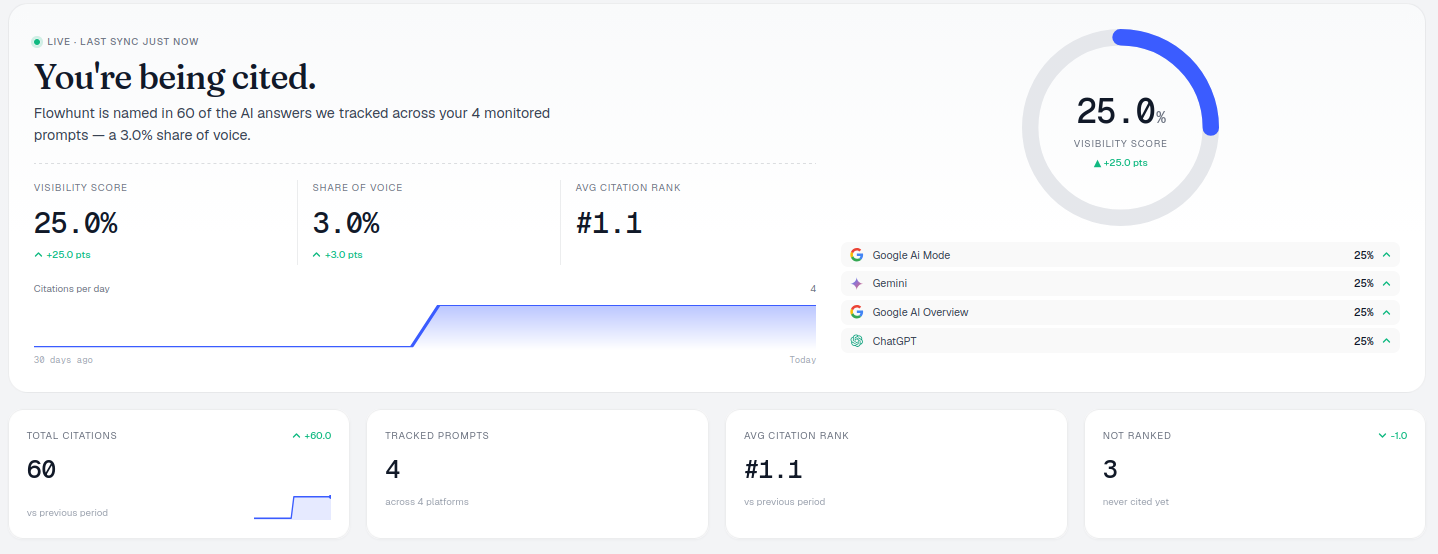
Source & Citation Intelligence shows which domains each engine cites and which of your pages win. UGC Influence surfaces the Reddit threads, YouTube videos and forum posts models cite in your category - frequently the answer to “why does a competitor own this prompt when our page is better”. Competitor Analysis auto-detects the brands models name alongside you.
FIX Part One: The Ecommerce SEO Tools That Move Citations
This is the layer the other three do not have, and the reason a store can actually act on what it sees.
Citation-Ranking Gap is the report that makes the overlap argument concrete. It finds queries you rank first for that no model ever cites, and pages models cite despite weak rankings. That is the ten percent, isolated and listed, which is the only way to work on it deliberately.
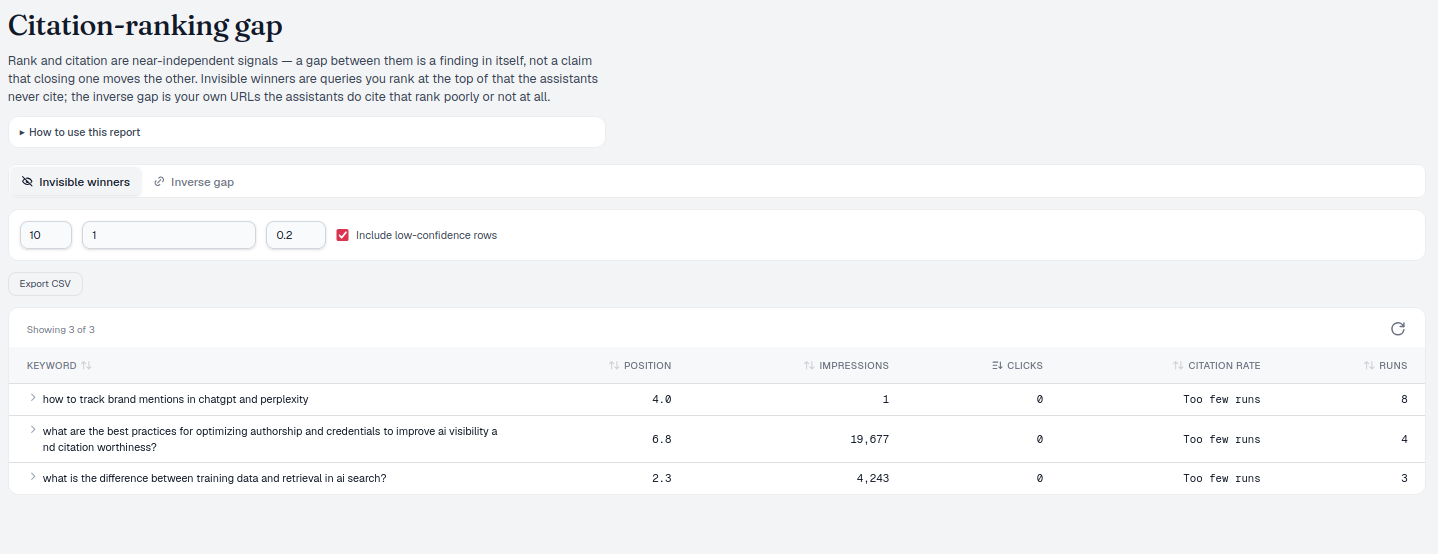
Around that sit the reports you would otherwise be running in a separate SEO tool, all built on live Google Search Console and Bing Webmaster Tools data:
- Unified Keywords - organic and paid in one row: clicks and position per search engine beside spend and conversions per ads account.
- Striking Distance - the keywords sitting just outside the positions that earn clicks, grouped by the page that owns them and ranked by modelled upside, so the output is which page to work on next rather than a keyword list.
- CTR Gap - queries and pages earning fewer clicks than this site’s own click-through curve predicts for their rank, ranked by the clicks the gap is costing.
- Click Waterfall - why traffic moved, not just that it did: the change between two periods split into the queries, pages or directories that appeared, grew, shrank or vanished.
- Cannibalization Detection - queries where several of your URLs competed in the same period.
- Index Bloat - URLs shown but earning nothing, or that stopped appearing entirely.
- Content Freshness - how many URLs you and your competitors add, update and remove from your sitemaps daily, and whether fresher pages actually win.
- Paid-Proven Gaps - search terms you pay for and have never had an organic impression on. The demand is already proven by your own spend and there is no page for it.
- Annotation Outcomes - log the change you made, state what you expected, and let the platform grade the outcome against real traffic and rank data.
Plus live API tooling rather than reporting alone: sitemap submission, Google URL inspection, Bing URL submission with IndexNow push, and Bing crawl activity - which has no Google Search Console equivalent.
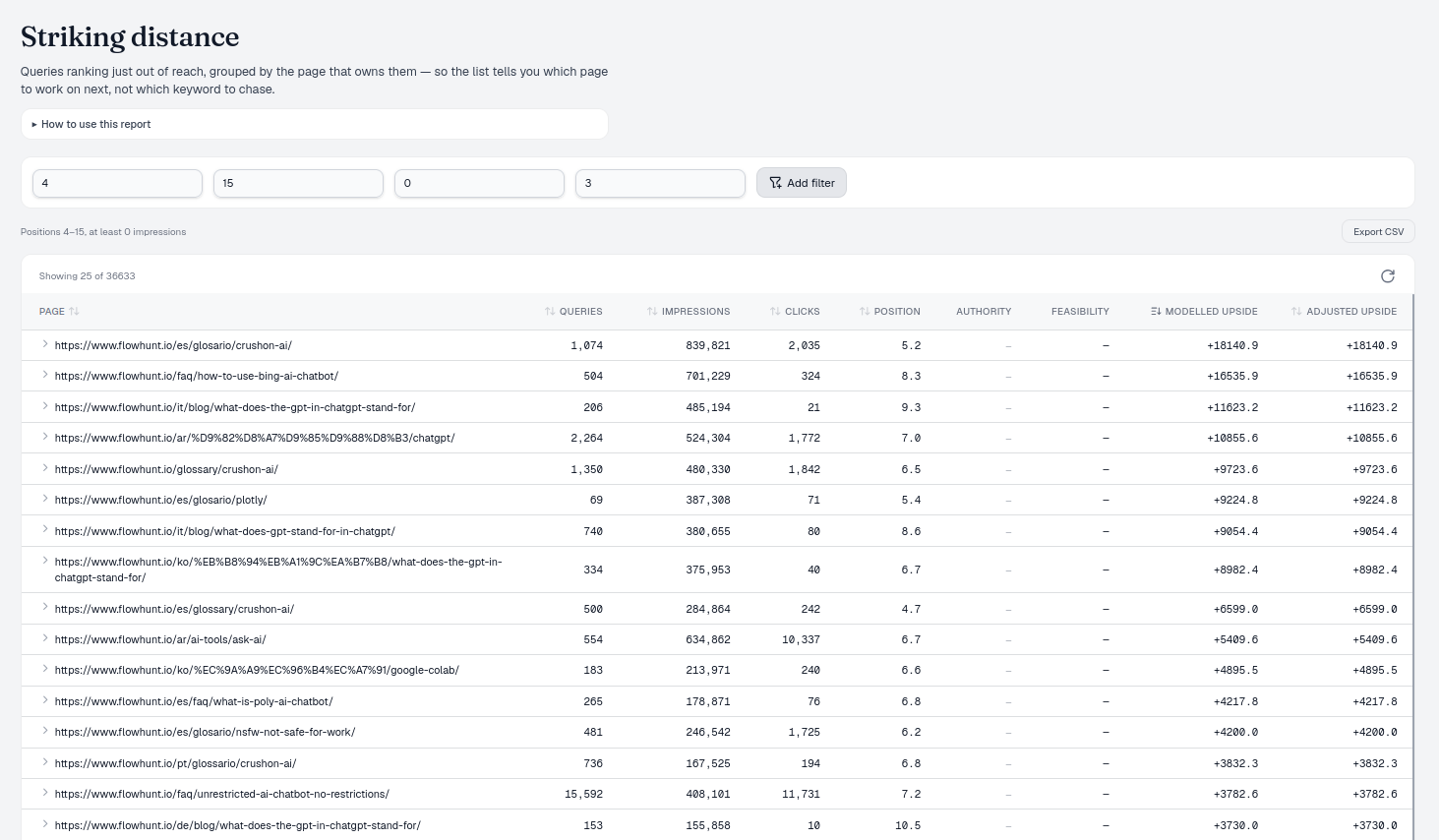
The point is not that these are novel - they are ordinary SEO reports, and that is precisely the argument. The novelty is having them in the same product as the citation tracking, so the report that tells you a prompt was lost and the report that tells you which page to fix are one click apart.
FIX Part Two: Generative Engine Optimization for Ecommerce
The genuinely new work. AI agents do not see your storefront; they see an accessibility tree, a robots file, structured markup and a commerce protocol. You can win every citation in your category and still lose the order because an agent cannot complete checkout.
AmICited scores six independent 0–100 readings and refuses to blend them: llms.txt, accessibility tree, allowed AI bots, sitemap URL count, WebMCP type, and Agentic Commerce Protocol (ACP/UCP) support.
Two details worth stealing regardless of which tool you buy:
- Robots versus reality. A robots.txt allow, a live CCBot-style fetch and a confirmed Common Crawl index entry are three separate facts, reported separately. A green robots check routinely hides a CDN or challenge-page block on the real request. A tool reporting one number here is reporting policy and calling it access.
- Declarative beats detected. A declarative WebMCP tool declaration outranks JavaScript-only detection, which the interface marks unverified rather than counting as a pass.
Green at 80+, amber 50–79, red below 50. “Not checked” stays unknown rather than being drawn as failure. Performance Impact sits beside it, measuring LCP, INP, CLS and TTFB per page and flagging citation risk - the same crawlers that feed answer engines skip slow pages.
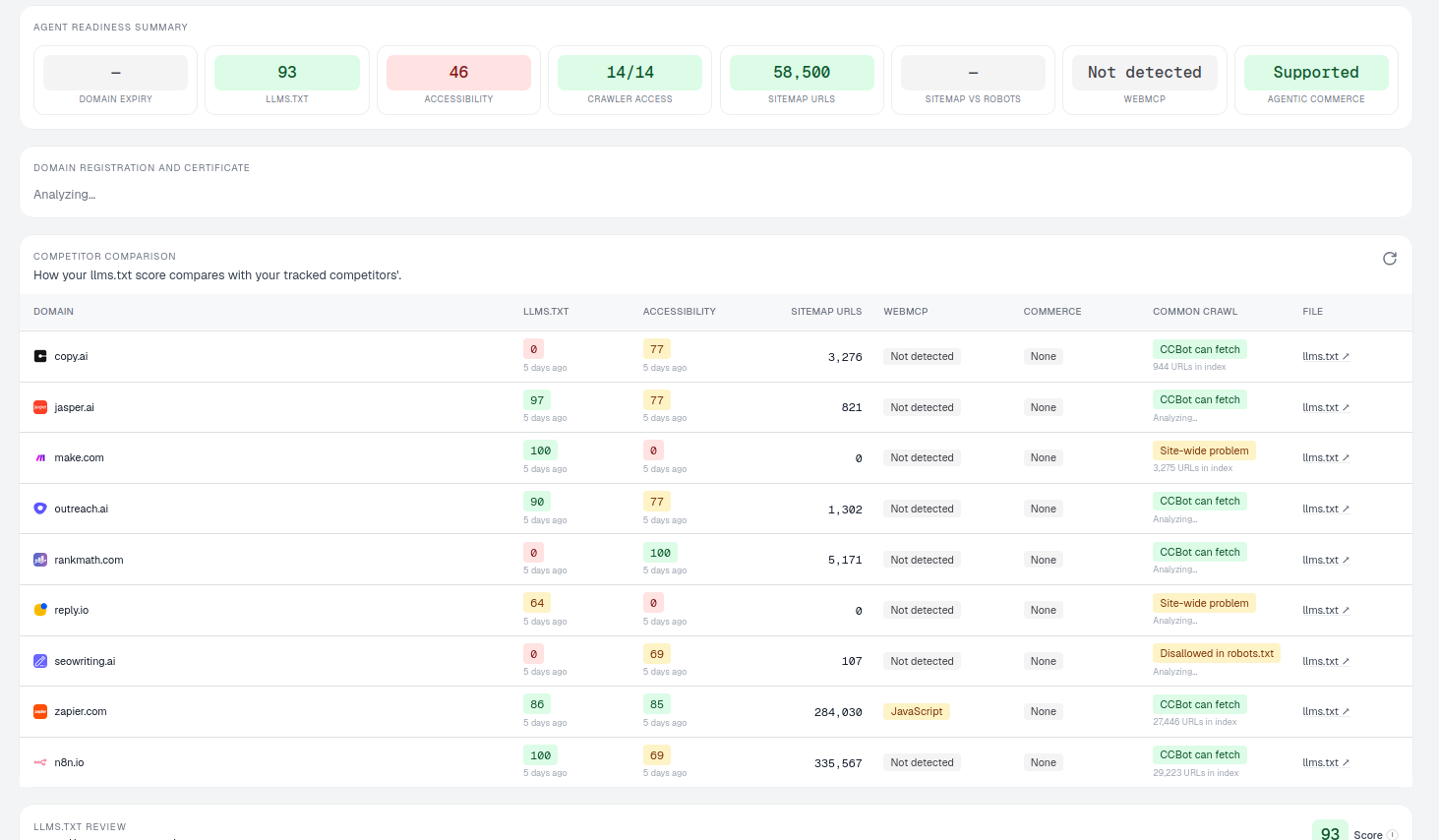
And when the gap is content rather than technical, SEO Agents and AI Content Generation take a losing prompt and produce a GEO-scored draft behind a human review gate - with Annotation Outcomes grading whether it worked. Everything is also exposed through an MCP server, so the same data is reachable from Claude Code or ChatGPT.
MEASURE Part One: Connecting the Ecommerce Order Book
This starts with configuration rather than charts, and it is load-bearing.
Order Statuses maps your shop’s own status strings to Not mapped / Placed / Paid / Completed / Shipped, with Cancelled as an independent checkbox. Payment Methods classifies each method by kind. Whether an order counts as revenue follows from the two together. An unmapped status or method earns zero revenue anywhere in the reports, by design, because counting money that has not arrived is the one mistake worth failing loudly on.
Currencies pulls daily ECB rates and stamps the rate on each order at import, so a later rate change never rewrites history. Cost Inputs holds packaging, net shipping, fixed overhead and payment fees as dated periods that apply forward only. Purchase Costs holds cost of goods per product, also forward only, so a correction never moves a margin you already reported to someone.
Data Health qualifies all of it: warehouse reconciliation assertions that can return pass, fail or not enough data; the share of revenue backed by a real mapped cost versus an assumption; and a complete worklist of products with no cost on record, ranked by the revenue resting on the assumption.
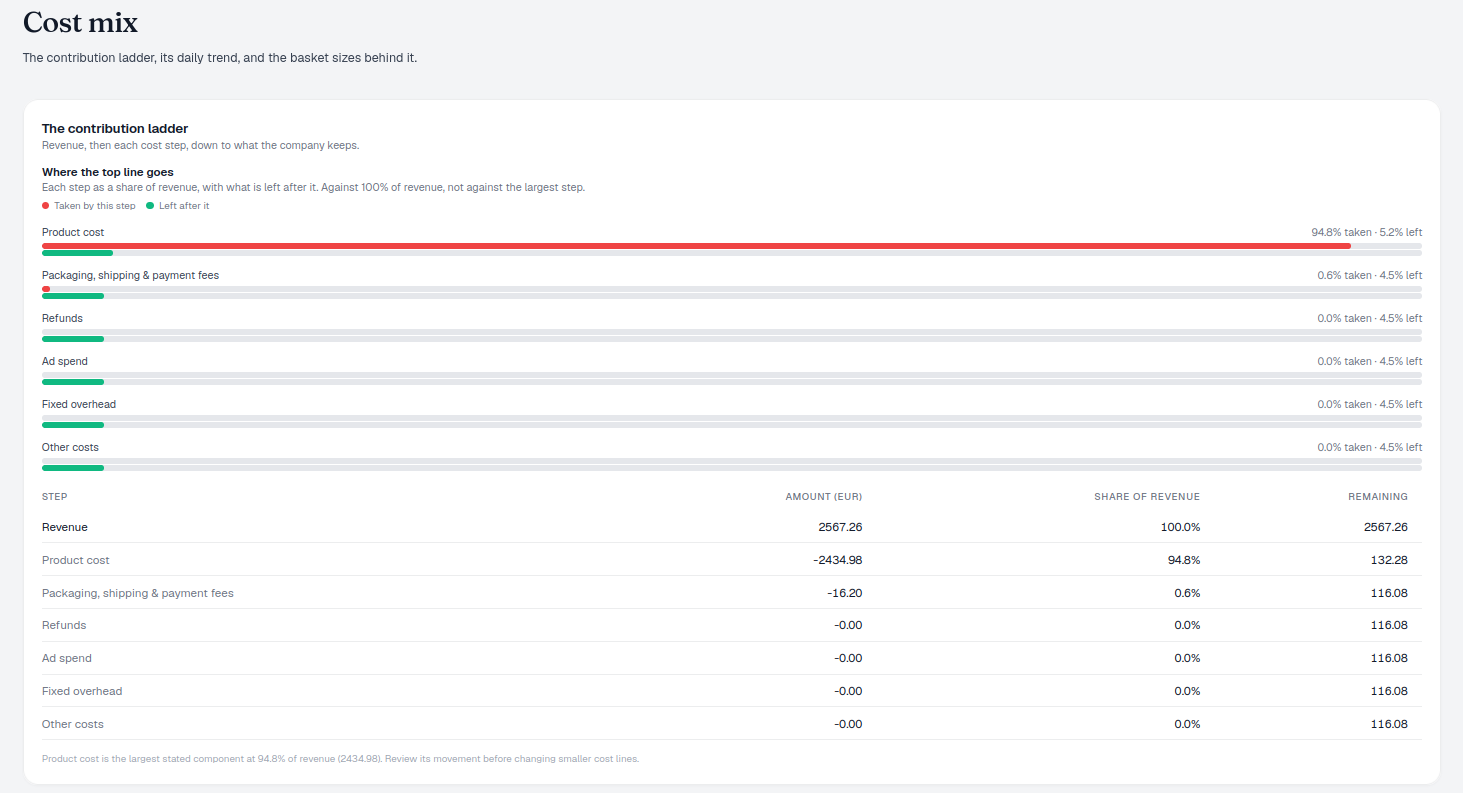
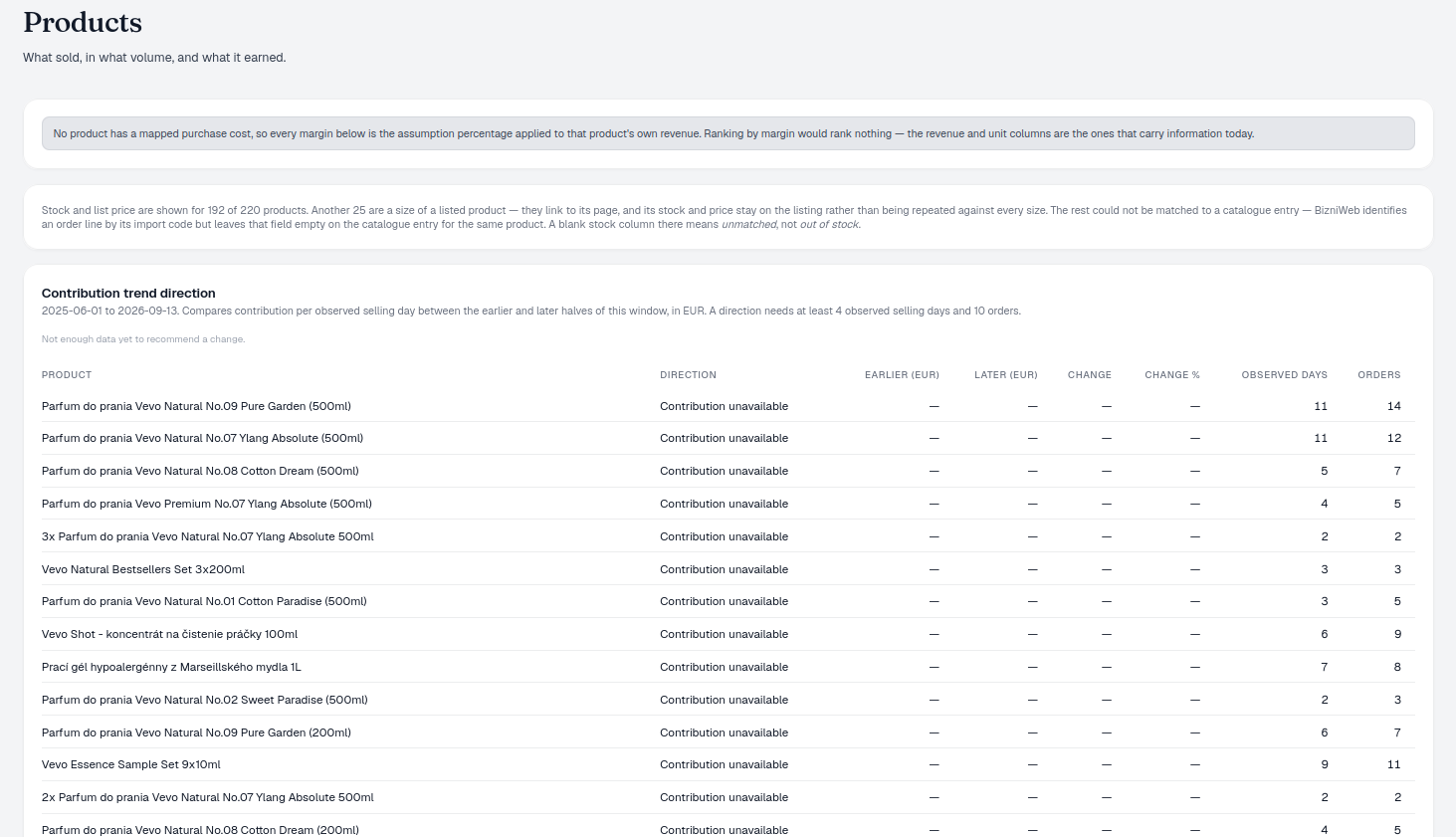
If that measured share is low, every margin figure in the platform is an assumption percentage applied to revenue - and the product says so on the page rather than in a footnote. Which is the correct behavior and also the warning: connecting a store gets you orders, not costs. Someone on your team enters those, or the contribution layer is decoration.

MEASURE Part Two: Contribution Margin and Store Profit
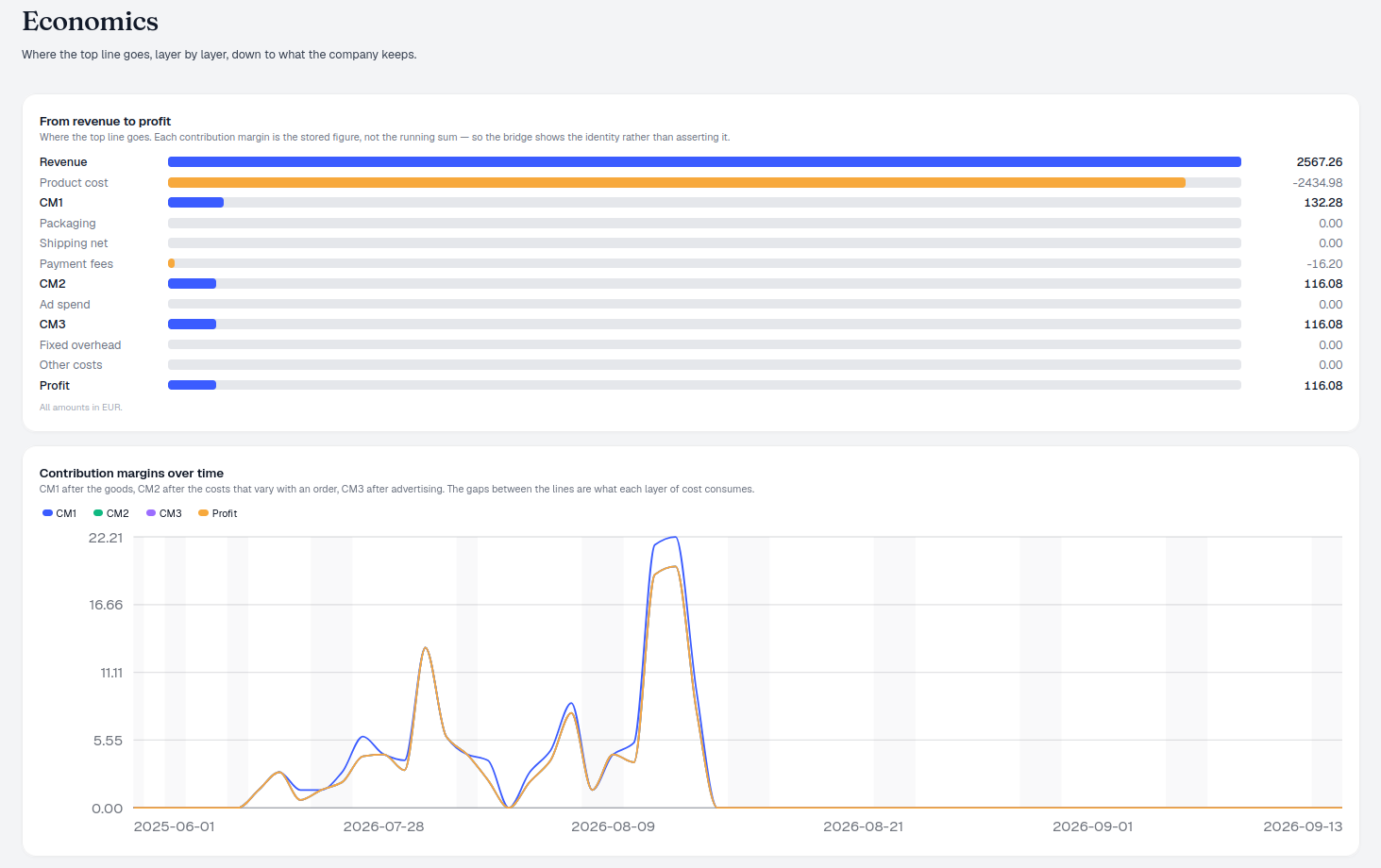
Economics fixes the vocabulary:
- CM1 = revenue − product cost
- CM2 = CM1 − packaging, shipping net, payment fees
- CM3 = CM2 − ad spend
- Profit = CM3 − fixed overhead and other costs
Each margin is the stored figure rather than the running sum, so the bridge demonstrates the identity instead of asserting it. If the stored totals and the component arithmetic disagree you get a reconciliation notice, not a chart forced to balance.
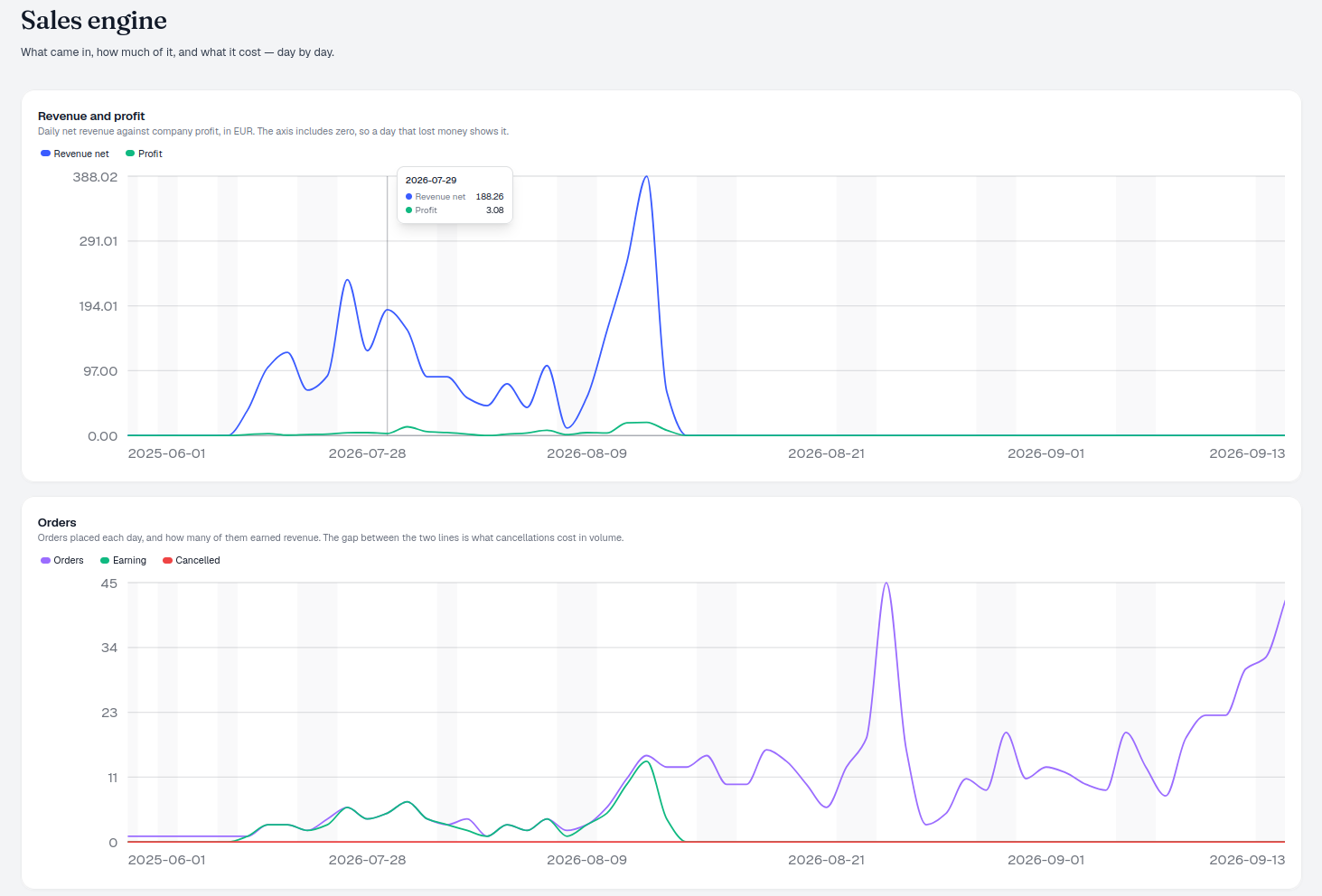
Sales Engine is the daily ledger: six charts and a nineteen-column P&L. Three decisions inside it are worth noticing - the revenue-and-profit axis includes zero so a losing day looks like one; cost components are separate lines rather than stacked, because a stack hides which line moved; and average order value divides by earning orders only. A day with no orders has no row rather than a row of zeros. The shop was closed, not loss-making.
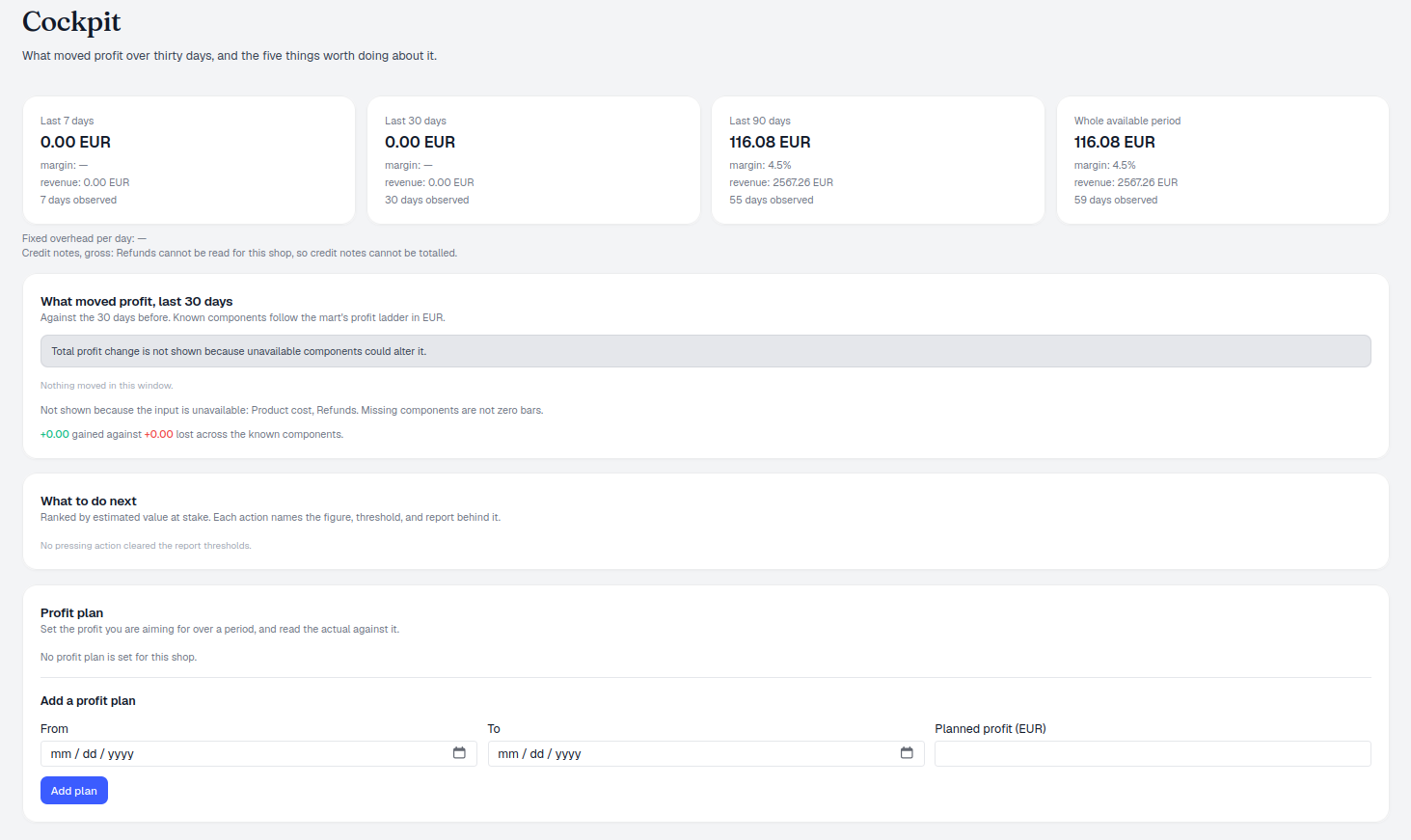
Cockpit compares the last thirty days with the thirty before and splits the profit change into eight components. Two guardrails: the drivers must sum to the profit change actually recorded in the ledger, or the residual is named and the total withheld; and under four daily observations or ten realized orders in either window it declines to draw a bridge at all. Unknown components are named and omitted, never drawn as zero.
MEASURE Part Three: Profit True ROAS for the AI Channel
Profit-true ROAS reports three returns from the same spend:
- Revenue ROAS - realized net revenue ÷ spend. Familiar, and blind to costs.
- CM2 ROAS - contribution after product and order costs ÷ spend.
- CM3 ROAS - contribution after advertising ÷ spend. The profit-pressure number.
Window totals sum the money first and divide once rather than averaging daily ratios. When cost inputs are incomplete, CM2 and CM3 read unavailable instead of quietly falling back to revenue and calling it profit. The page states its own ceiling: CM3 is contribution after advertising, not company profit.
A channel showing 4× revenue ROAS and 0.9× CM3 ROAS is not a good channel having a slow month. It is a channel you are paying to run.

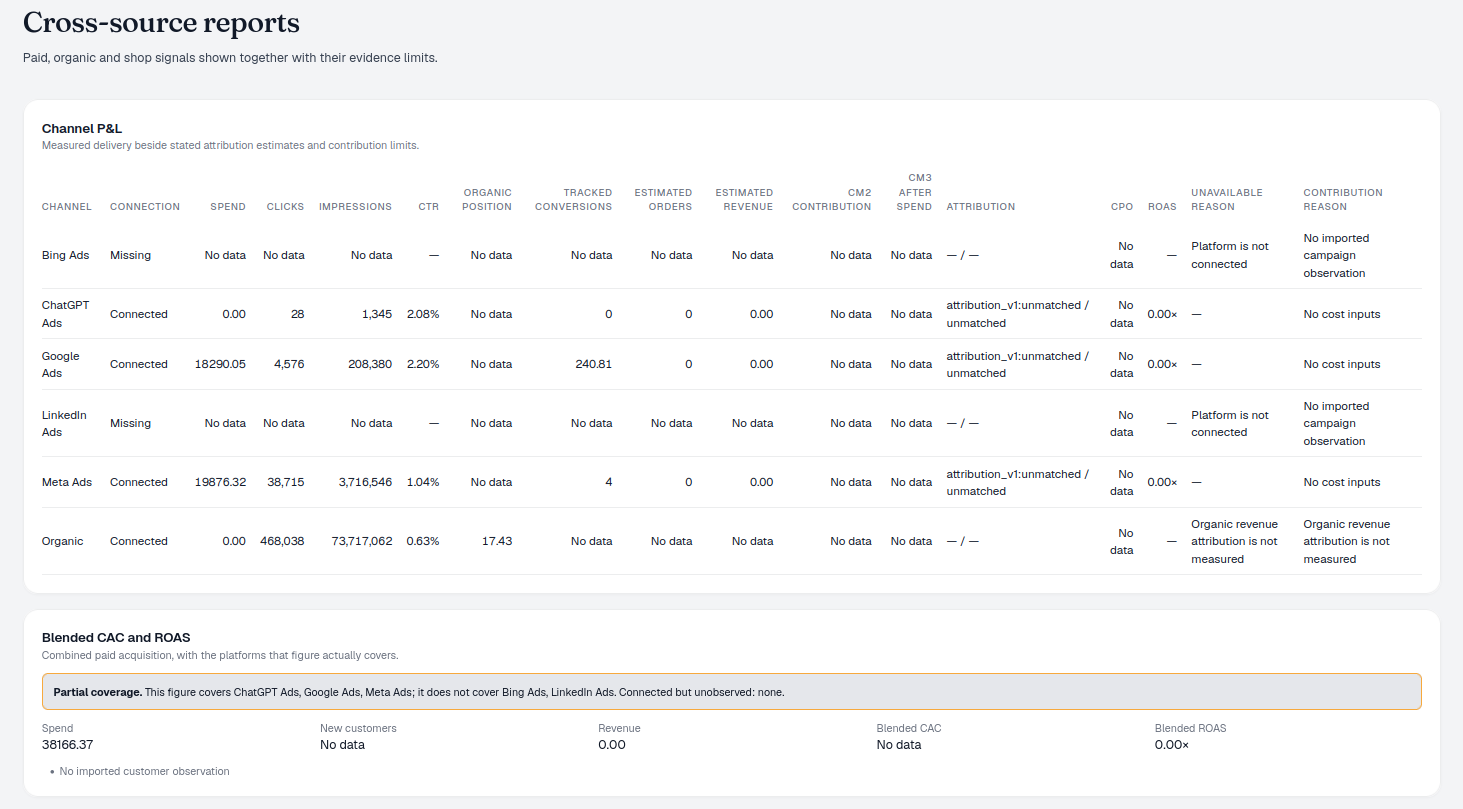
Cross-source Revenue Attribution puts paid delivery, organic search and the order book in one report without pretending they are one measurement system. Four views, each with its own evidence boundary, deliberately never collapsed into a single attribution score:
- Channel P&L - measured delivery, the platform’s own conversion claim, the estimated shop outcome with its method and confidence, and an explicit reason wherever something is unavailable. Organic ROAS reads undefined rather than zero, because it has no spend denominator.
- Blended acquisition - paid spend over customers the shop identifies as new, with connected, missing and connected-but-unobserved platforms held as three separate states.
- Paid–organic lift - ad spend against branded and non-branded Search Console clicks across candidate lags, carrying an association-only flag and a named list of confounders.
- Hourly alignment - each hour’s share of spend against its share of realized orders.
Two sentences govern it. Delivery is not attribution. And, printed on the page itself: no individual credit assignment - this report cannot tell you which channel caused a particular first purchase, let alone which prompt did. It says so rather than implying otherwise with a confident pie chart. That is the honest ceiling of this entire category, and it is the reason the report is built as four separate views instead of one number.
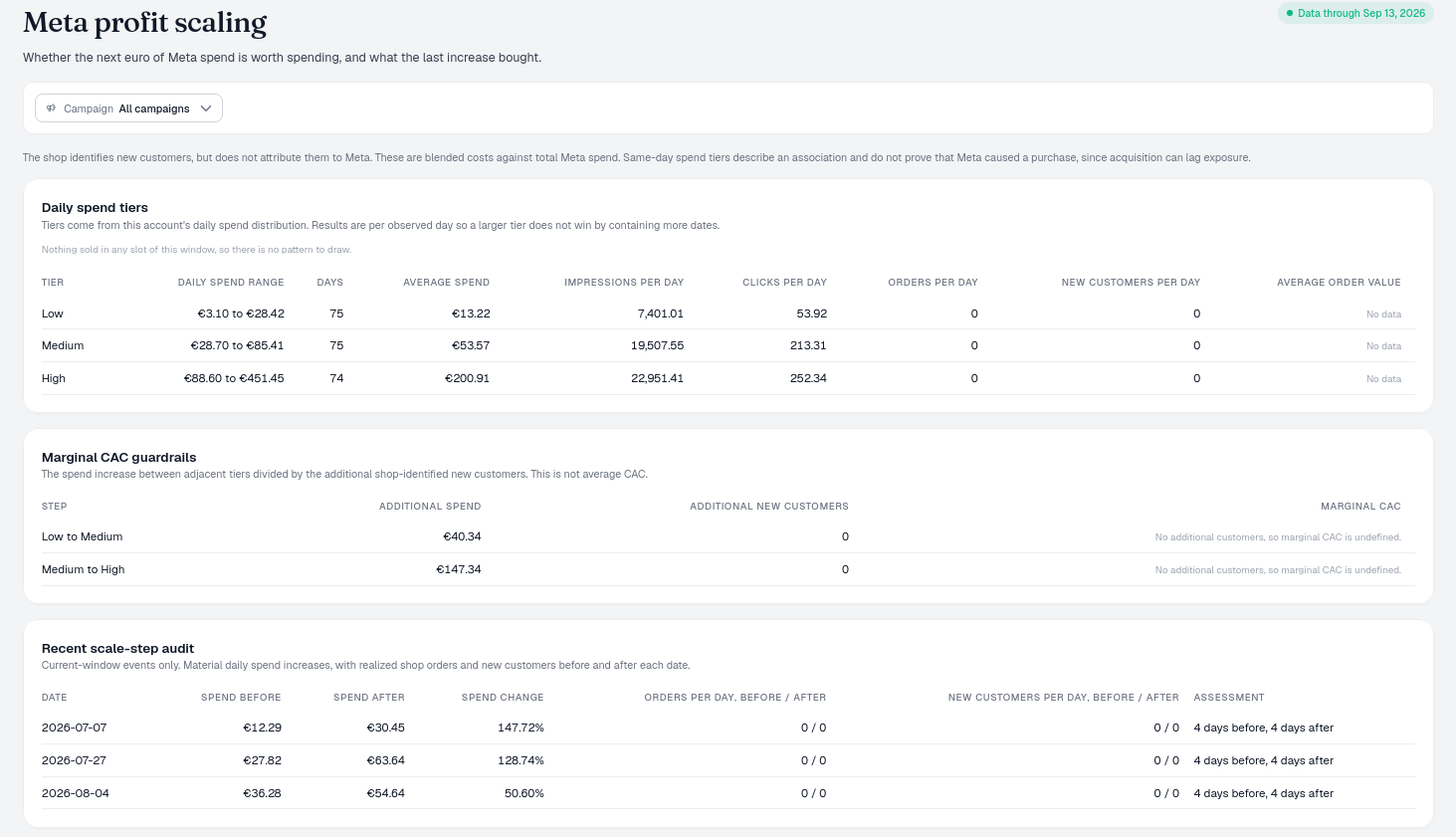
Alongside those: Attribution Reality holds a platform’s claimed conversions next to the shop’s realized orders as two ledgers rather than one merged number. New-customer CAC divides spend by first-ever purchasers, window-wide because acquisition lags exposure. Profit Scaling derives spend tiers from terciles of your own account’s daily spend, compares marginal CAC against mature contribution LTV, and returns only scale, hold or unavailable. The same treatment runs across Google Ads and Bing Ads, and ChatGPT Ads gets its own campaign manager, conversion pixel and server-side Conversions API.
What Else the Ecommerce Order Book Brings
Once the store is connected, the catalogue and customer base come with it - and those answer whether an AI-acquired customer was worth acquiring.
- Products and Assortment - every SKU by revenue and contribution, with a top-12 chart where a tall revenue bar and almost no contribution under it flags a product sold at cost; and a SKU Pareto with running cumulative share.
- Entry Products - repeat rate broken down by the first product someone bought, with cohort size beside every rate. This tells you whether the cheap item AI keeps recommending is an entry product or a dead end.
- Lifetime Value - cumulative spend by cohort, excluding cohorts under 90 days, with the churn threshold derived from this shop’s own median gap between orders rather than a fixed day count. Cohort payback is never projected past what has been observed.
- Segments - RFM boundaries from that same median gap, campaign plan ranked by expected value adjusted for the share of each segment you can actually reach by email.
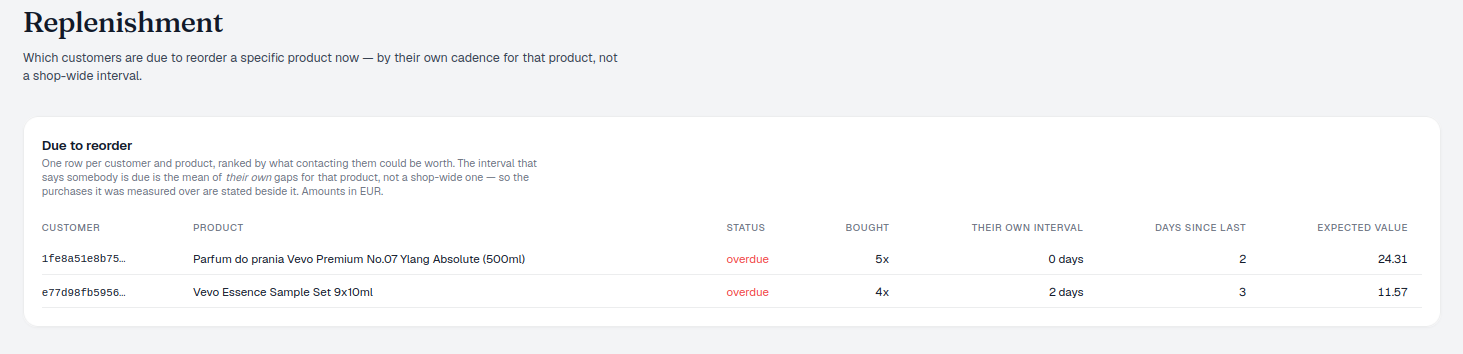
- Replenishment - customers due to reorder a specific product now, by that customer’s own mean gap for that exact product, ranked by expected value rather than lateness.
- Geography, Geo Profitability, Calendar Patterns, Order Mix - where and when the shop sells, with margin withheld below 30 orders in any market.

Where This AI Visibility Tool Stops
- It does not enrich your product feed. It will tell you which SKUs never make an AI answer. It will not rewrite your titles and attributes and push them to a shopping engine. Ranketta does, and if feed quality is your bottleneck that is a real reason to buy a different tool.
- The contribution layer depends on data you enter. Product costs, order-cost inputs and status mappings are your inputs. Until they exist, every margin is an assumption percentage - flagged as one, but still not a measurement.
- It cannot attribute an order to a prompt, and neither can anything else. We ship more numbers that look causal than the others do, which makes the temptation larger, not smaller. Paid–organic lift is an association. Blended CAC is a ratio. Profit Scaling describes an observed relationship. Causal proof still needs a holdout or a geo test.
- Unmapped-is-zero is strict. A half-configured account looks broken rather than optimistic. Right default; costs you an afternoon of setup.
- There is a lot of it. Ninety-nine reports is a lot of surface for a two-person marketing team. If you want one dashboard and three numbers, this is more product than you need.
2. Ranketta: Best Ecommerce SEO Tool for Product Feed Work
The most serious competitor here for a store, and on one axis it is ahead.
It clears the first job comfortably: product-level tracking of which SKUs win AI recommendations and which get skipped, plus a Best Sellers view ranking the products AI recommends most often by share of voice. Then it does the thing AmICited does not - a merchandising agent rewrites titles, descriptions and attributes with a confidence score on every fix and connects the resulting feed to AI shopping engines. Platforms: Shopify, Adobe Commerce, Shoptet, Wix, BigCommerce, Amazon and Walmart, with Google Merchant Center and Google Analytics as data sources. Plus a site audit, a content studio, an MCP server, a Looker Studio connector and Cloudflare-based AI traffic attribution.
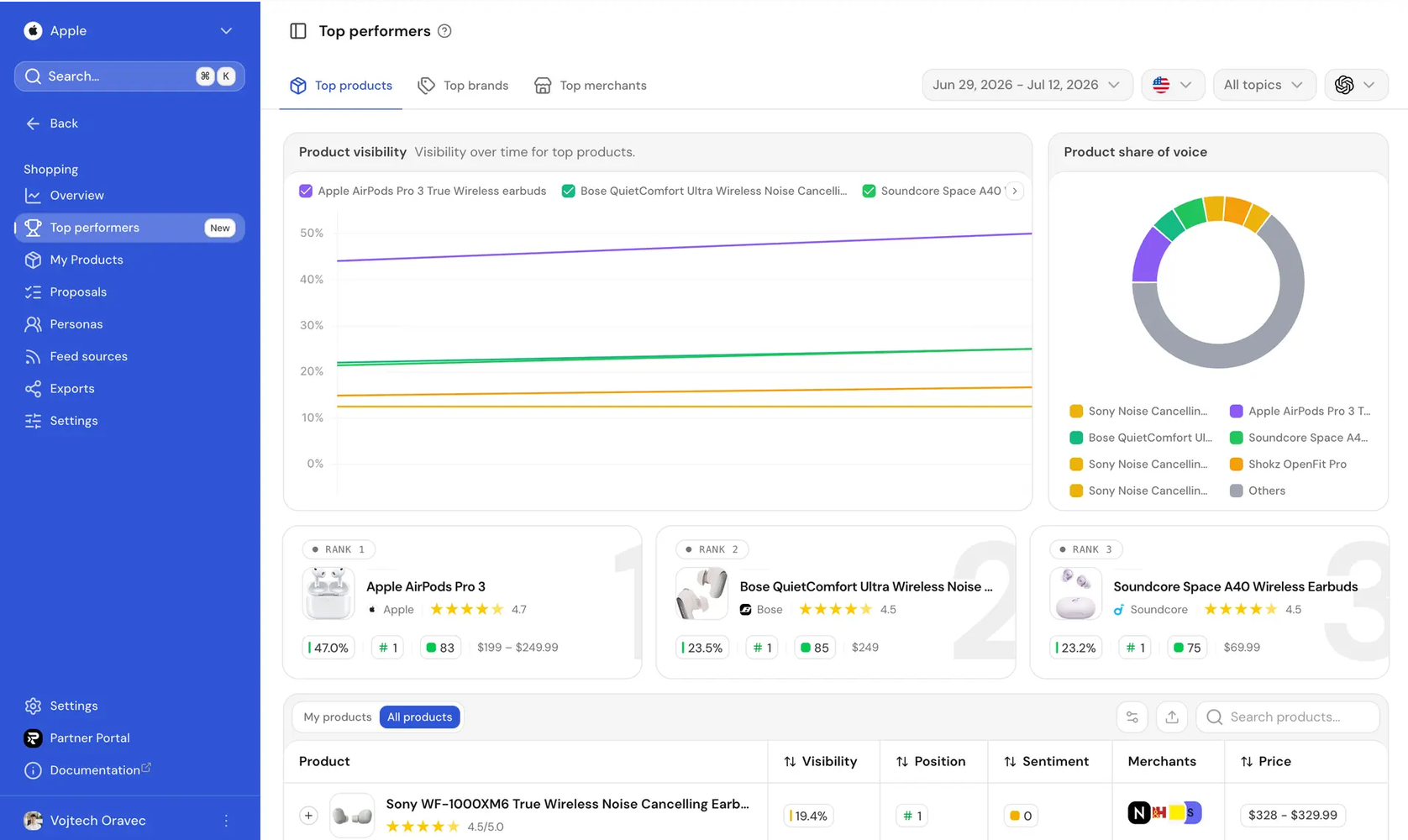
Where it stops: the second job partially and the third completely. Feed enrichment is genuinely search work, but there is no Search Console layer - no striking distance, no CTR gap, no click waterfall, none of the reporting you need for the ninety percent that is not the feed. And there is no order book, so no margin, retention or channel view. If your problem is our listings are thin and AI never picks us, Ranketta is arguably the better buy. If your problem is we need to work the whole search surface and report what it returned, it is not.
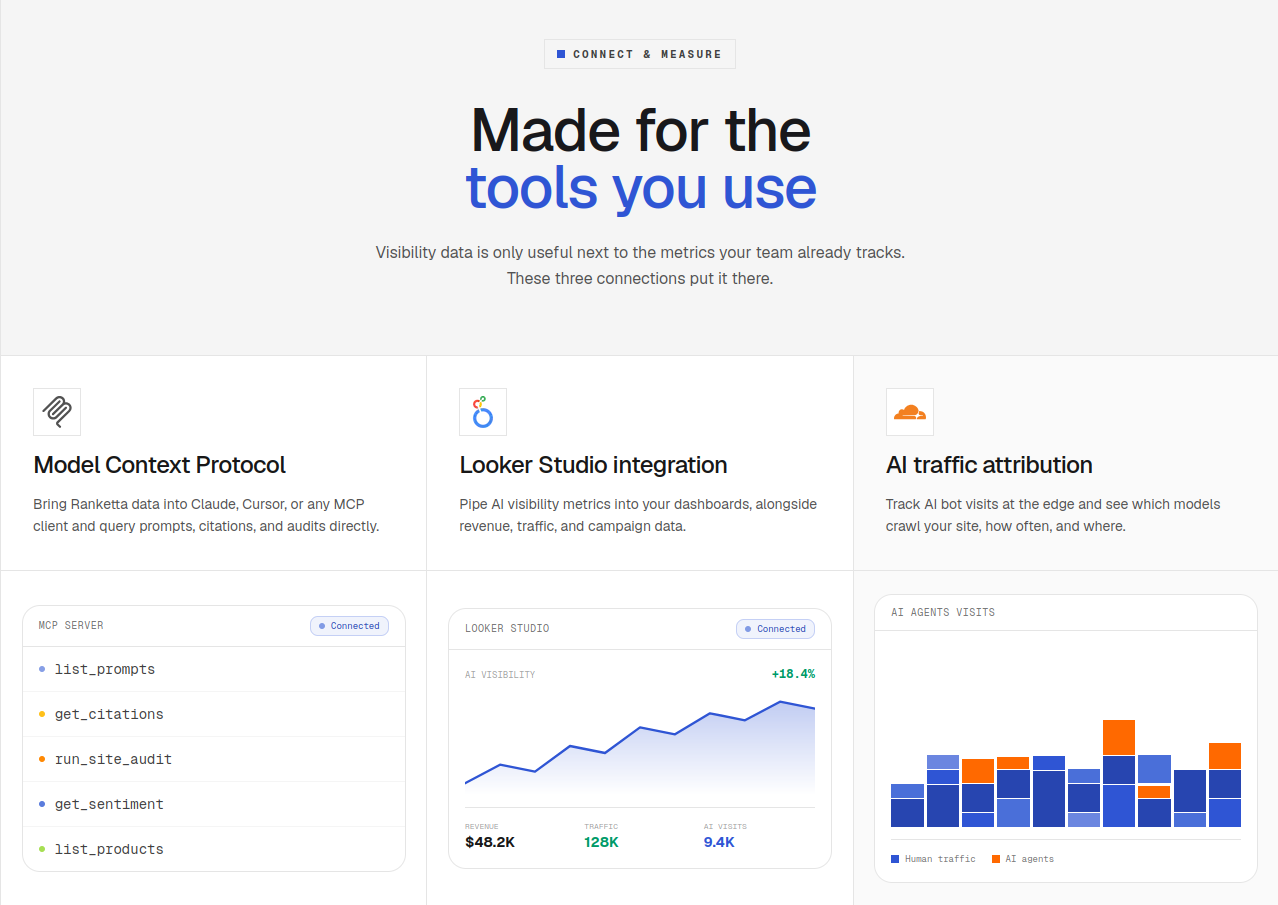
Ranketta’s team declined us a trial as a competing vendor, so the screenshots above are sourced from their own public site rather than a live account - noted here for transparency, consistent with how this piece treats evidence everywhere else.
3. Promptwatch: Best AI Crawler Tracking Tool for Ecommerce
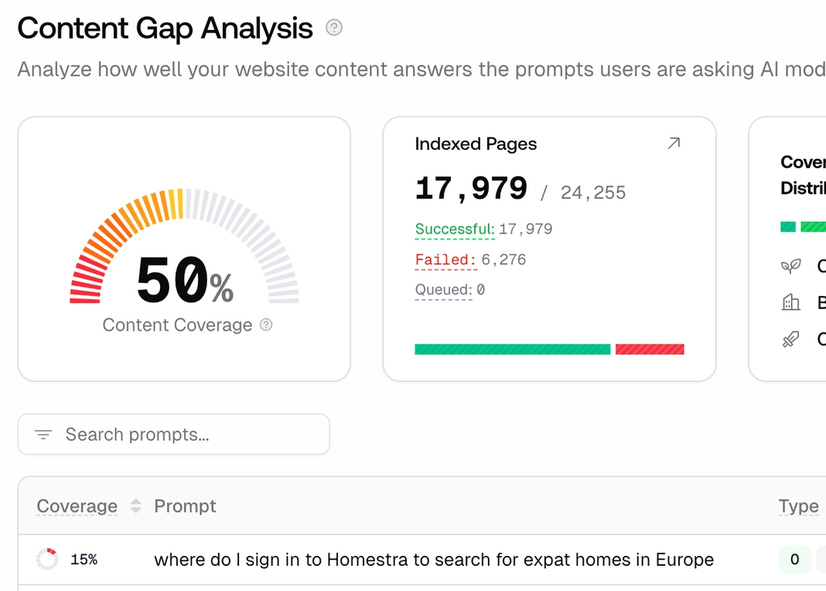
Promptwatch comes at this from the infrastructure side. Prompt tracking, citation analysis and visibility scoring are all present, but the distinctive part is Agent Analytics: real-time visibility into AI crawlers reading your pages, ingested at the CDN edge through Cloudflare, Fastly or Vercel. Add offsite citation tracking, Reddit and YouTube monitoring, content gap analysis, briefs, a content calendar, a content agent, and an Entity Tracker covering brands, products and competitors.
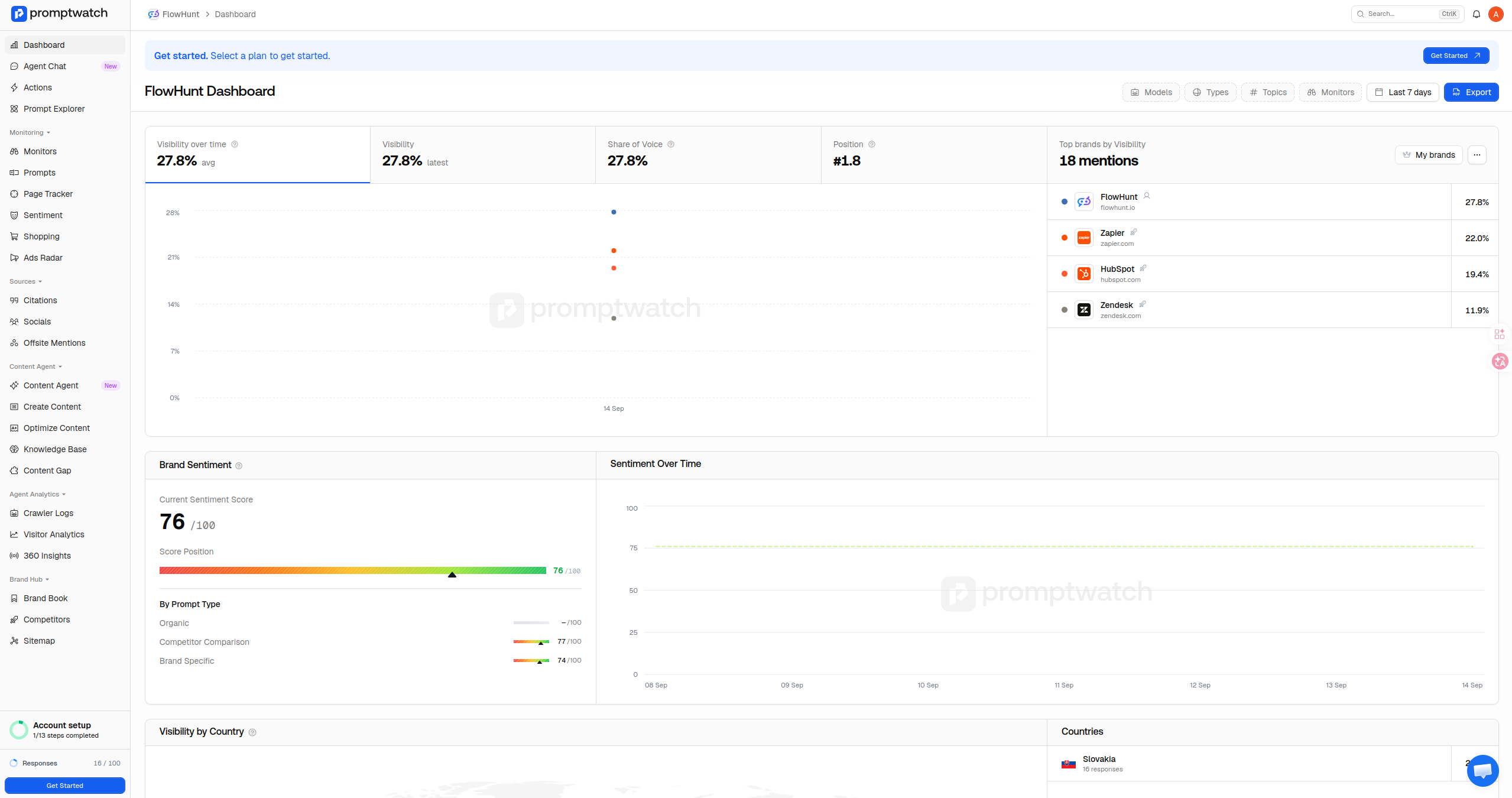
Engine coverage is broad: ChatGPT, Gemini, Claude, Perplexity, Grok, DeepSeek, Copilot, AI Overviews, Mistral and Meta AI.
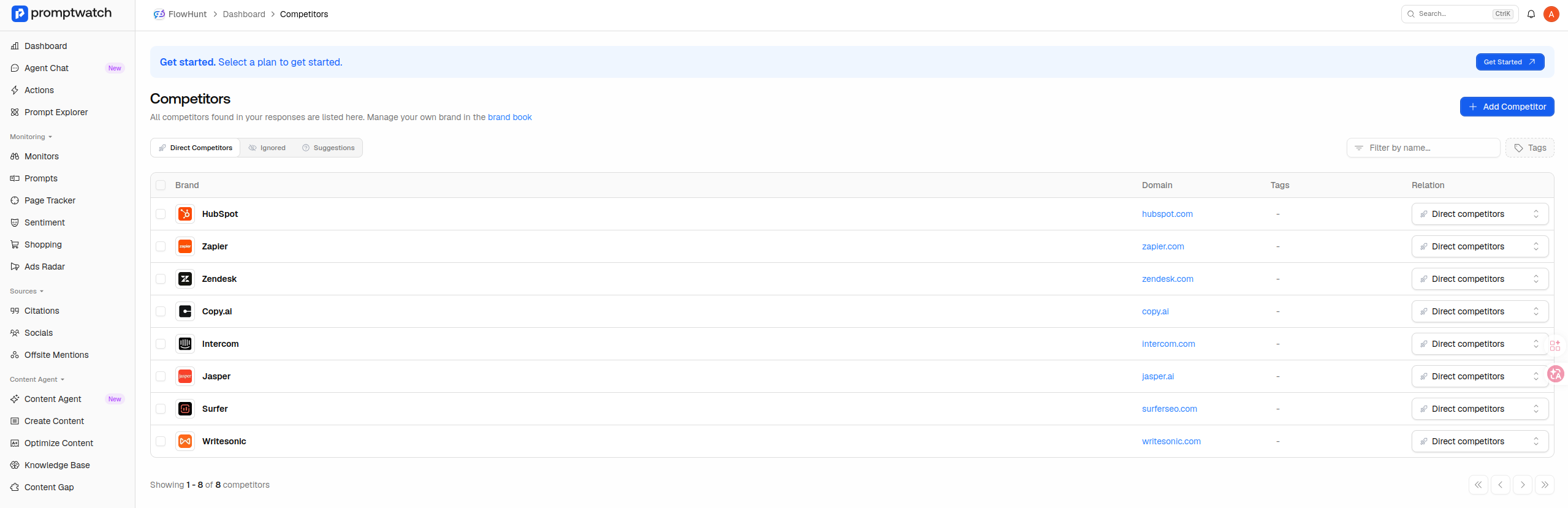
Where it stops: partially at the first job - the Entity Tracker sees products, but this is not SKU-level shopping analysis - and completely at the third. On the second job it covers the crawl side well and the search side not at all. It is a log-centric tool rather than a search or order-centric one. If your engineering team already treats crawler behavior as an observability problem, Promptwatch fits that mental model better than anything else here.
4. Otterly.ai: Cheapest AI Visibility Tool to Start With
The easiest way to start. Prompt research, search analytics, competitive benchmarking through Brand Report, sentiment analysis, domain citation tracking, a crawlability checker, content audit, recommendations, workspaces, CSV exports, a Query Fan-Out tool, 65+ countries and languages, a Looker Studio connector, MCP, an API and Agent Analytics.
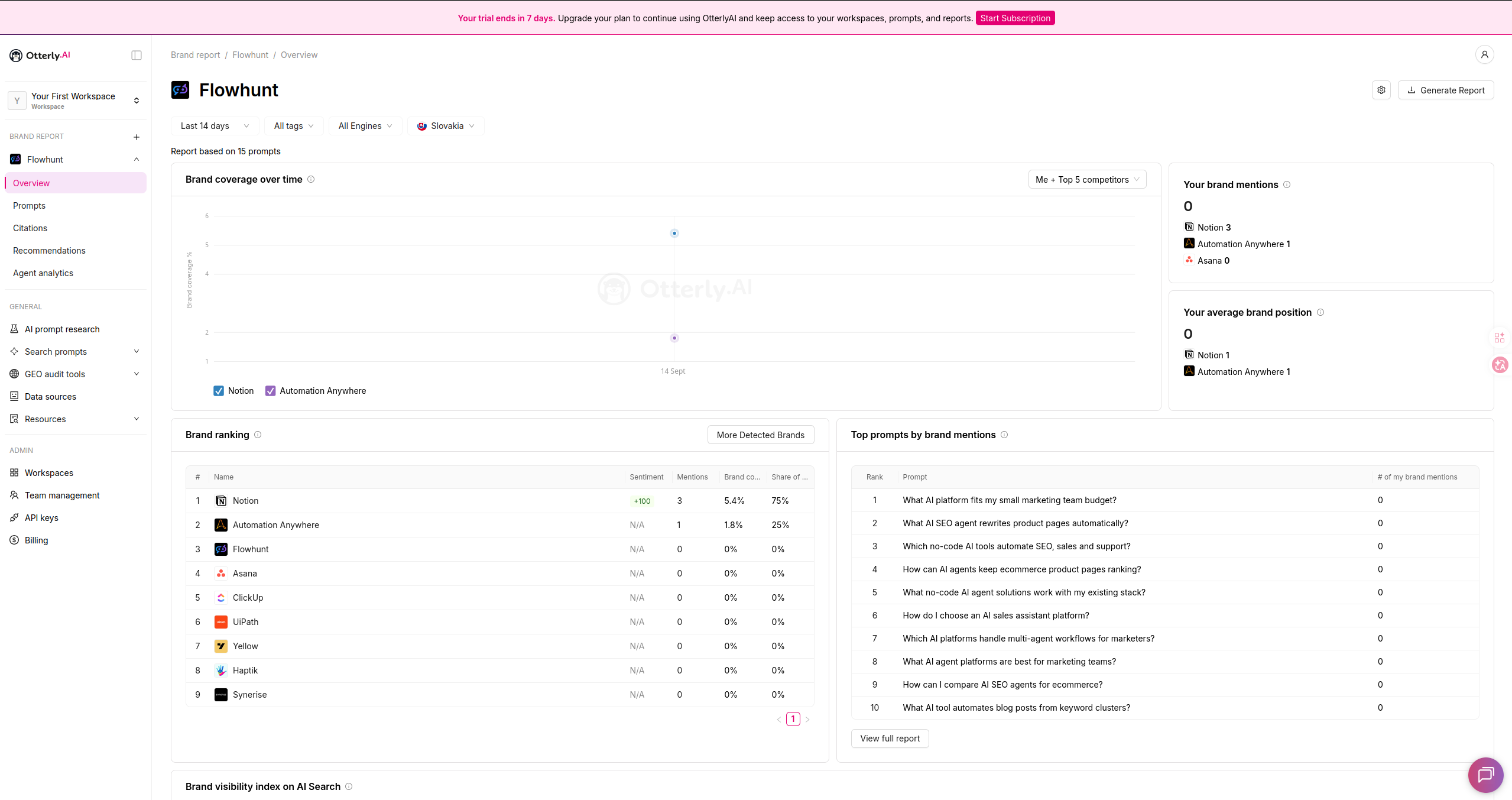
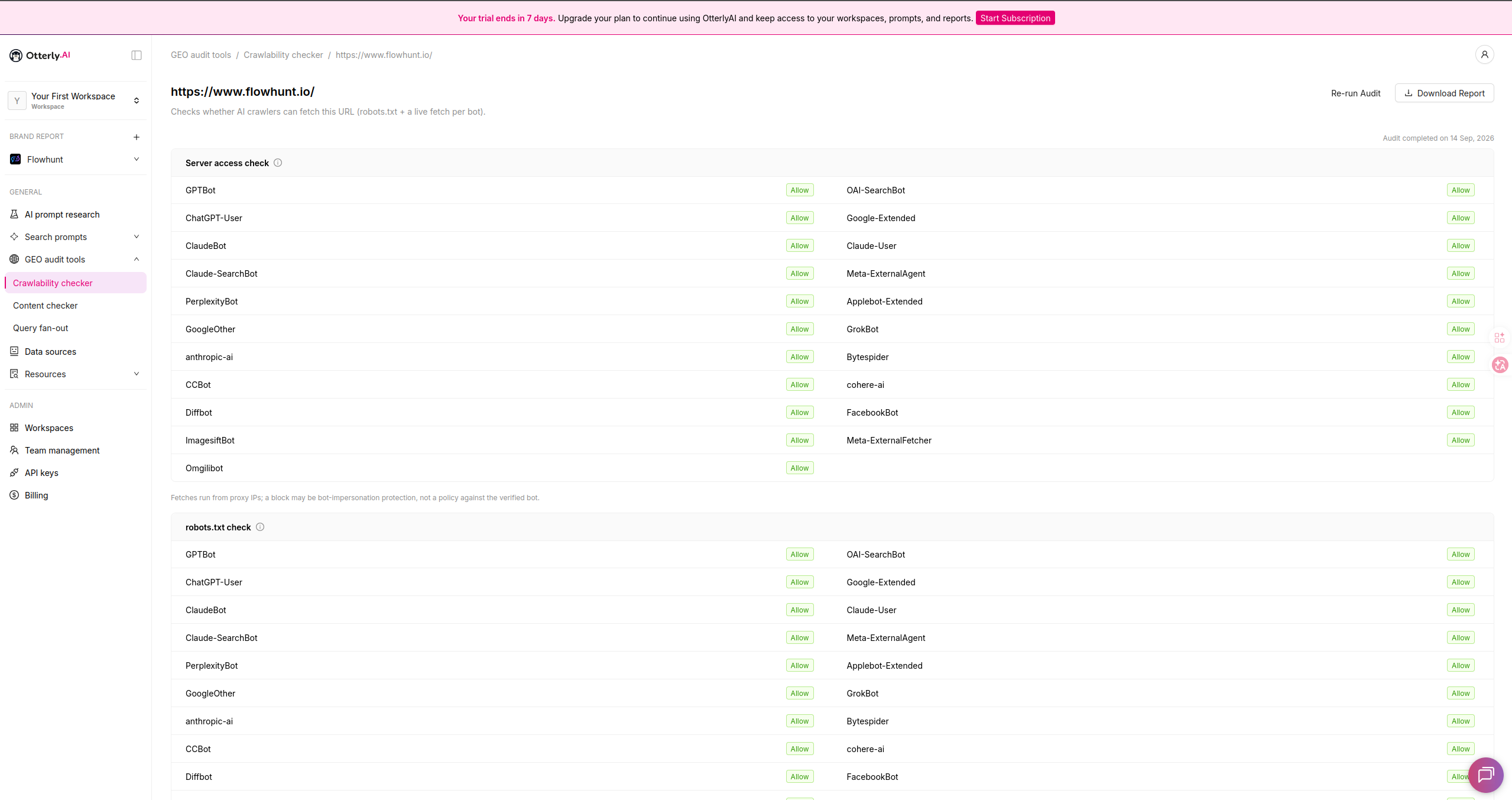
Where it stops: the first job. Otterly tracks ChatGPT ads and shopping-card appearances, which genuinely tells you whether you show up in a shopping answer. It does not track individual SKUs, connect a store, or report organic search performance. It is a brand visibility tool that happens to see shopping surfaces - which is what a lot of teams need, and is not what a store needs. For a closer side-by-side, see our Am I Cited vs OtterlyAI comparison.
What These AI Visibility Tools Actually Cost
Entry prices in this category are close enough to be misleading. The number that matters is the price of the plan that does your job.
| Entry | What entry actually gets you | Job 1 (see) | All three jobs | |
|---|---|---|---|---|
| AmICited | €50 Starter | 1 domain, 200 prompts, 10 competitors, all Search Console and Bing reporting - no daily scheduling, no store connector | €50 | €120 Pro |
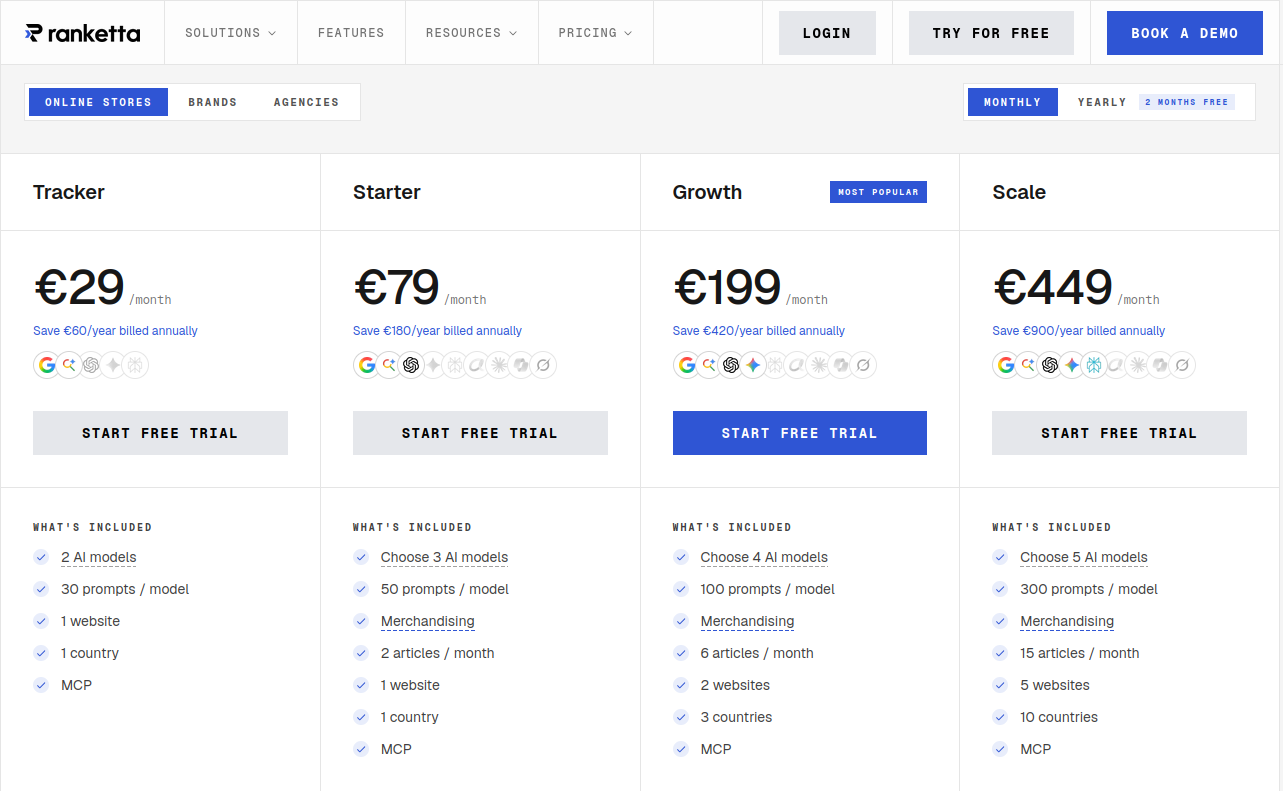
| Ranketta | €29 Tracker | 2 models, 30 prompts per model, 1 site, 1 country | €29 (€79 for merchandising) | not available |
| Promptwatch | $0 Explore | free tier, then $95 Essential | $95+ | not available |
| Otterly.ai | $29 Lite | 15 prompts, 4 engines, 1 workspace | n/a - no SKU tracking | not available |
Four things the left column hides:
AmICited gates the store behind Pro, but not the search layer. AmICited Starter at €50 includes Google Search Console, Bing Webmaster Tools and GA4, which means the whole ninety-percent argument is available on the entry plan. What Starter does not have is daily prompt scheduling or any ecommerce, ERP, ads or Stripe connector - so the third job is a €120/month product. Quoting €50 for the full argument would be a bait-and-switch. Engines are tiered too: core engines (ChatGPT and Perplexity) on every plan, Copilot from Pro, Claude, Grok and DeepSeek from Premium (€500). Billing is credit-based - one prompt on one engine costs 0.015 credits, so a prompt tracked daily across eight engines is eight responses a day. Credits do not roll over.
Ranketta prices prompts per model, and the model count is the tier gate. Thirty prompts per model on two models is not thirty prompts spread across two models, and premium engines - Claude, Grok, Copilot, Amazon Alexa - only appear from Starter (€79) up. Growth €199, Scale €449. Merchandising credits are separate at €1 per 1,000 with a €50/month minimum. For a real catalogue this is not a €29 tool.
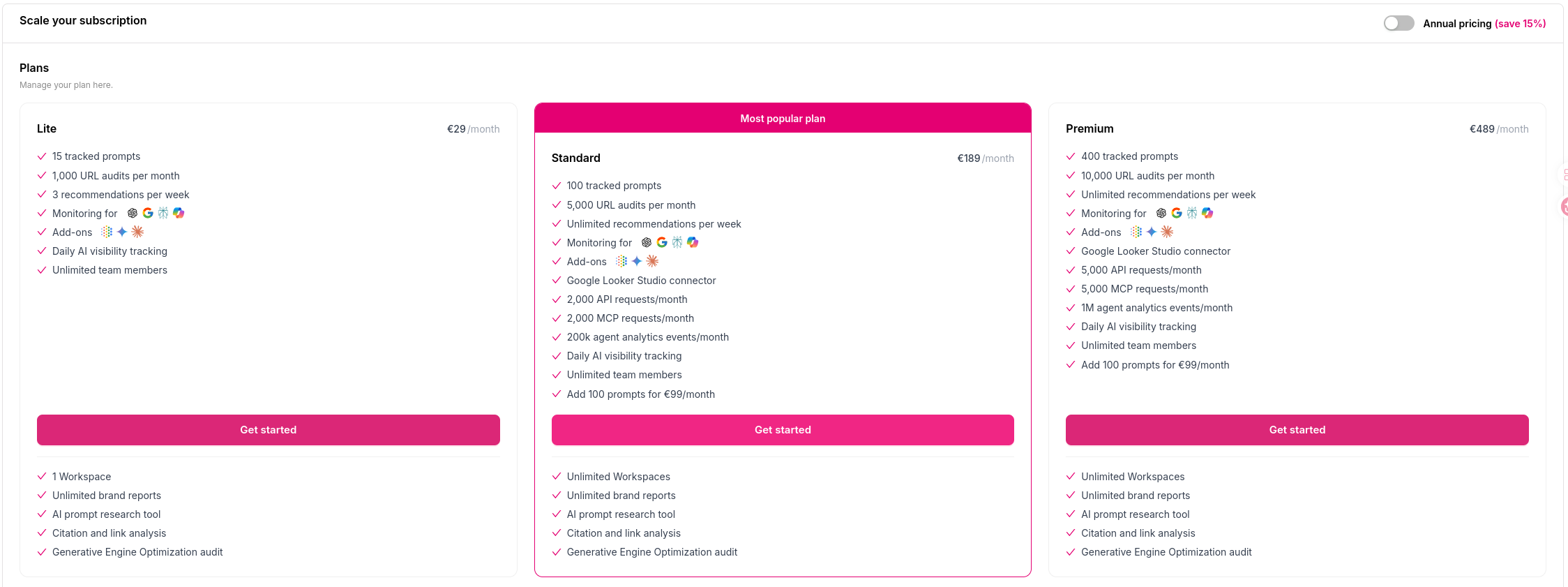
Otterly’s $29 is four engines. Google AI Mode, Gemini and Claude are paid add-ons at $9–$149 per month each for the first two and $29–$439 for Claude depending on tier. Standard is $189 with 100 prompts, Premium $489 with 400, Enterprise from $1,000, and overage runs around $99 per 100 prompts. We did not get per-tier add-on values so we will not invent a realistic total - do the arithmetic for your own engine list before treating $29 as the price.
Promptwatch did not publish per-tier limits when we checked on 14 September 2026. Tiers are Explore free, Essential $95, Professional $245, Business $579. Prompt limits and log caps did not render, so we are not repeating the numbers a third-party review reported. Ask them directly.
Prices are listed in each vendor’s own currency and we have not converted them, because an invented FX rate in a pricing comparison is exactly the kind of confident-looking wrong number this article argues against.
The comparison that matters. For job one alone, Ranketta at €79 with merchandising is the strongest value on this page and it is not close. For all three, it is €120/month against not available at any price - a different kind of decision, and the only one where AmICited’s pricing is genuinely competitive rather than merely reasonable.
Ecommerce connectors: AmICited’s pricing page lists Shopify, WooCommerce, PrestaShop, Shoptet and BizniWeb. Confirm current live status in the app’s Data Sources screen before buying on a specific integration.
Choosing the Right AI Visibility Tool for Your Store
If your listings are the bottleneck - AI never names your products and your titles and attributes are thin - buy Ranketta. Feed enrichment is a real capability and nobody else here has it.
If you have no search tooling - you are tracking prompts in one tool and doing the actual work in Search Console and a spreadsheet - the ninety percent is where your time is going, and AmICited Starter at €50 covers it before you spend anything on the store layer.
If reporting is the bottleneck - you cannot tell finance what the channel returned - you need the order book and a contribution model. AmICited at Pro. Be honest about whether someone will enter the purchase costs, because without them the margin layer is decorative.
If crawler access is the bottleneck - your engineering team suspects AI crawlers are blocked, rate-limited or served the wrong thing - Promptwatch’s CDN-level Agent Analytics is the most direct answer, and AmICited’s robots-versus-reality check is the second.
If budget is the bottleneck - start with Otterly Lite, accept the four-engine limit, and upgrade when the tracking tells you something you want to act on.
For agencies running many small store accounts, the deciding axis is usually per-workspace pricing and client separation rather than any capability above. All four sell that differently.
The Strategic Playbook: How AI Shopping Engines Choose What to Recommend
Tool choice is only half the problem. The other half is understanding what the tools are actually measuring, which is why it’s worth stepping back from the vendor comparison and looking at how AI shopping engines decide what to cite in the first place.
What Is AI Visibility for Ecommerce?
Three things get conflated constantly, and the difference matters for where you spend effort:
AI-powered site search is a feature inside your own store, a chatbot or smart search box that helps a visitor who already arrived find the right product. It’s a UX investment. It does nothing for shoppers who never land on your domain.
Traditional SEO gets you ranked in Google’s organic results, which AI Overviews and AI Mode partly draw from, but ranking well doesn’t guarantee a citation. Google’s AI surfaces synthesize an answer and choose which sources to name, and that selection follows different rules than the ten blue links.
AI visibility is about being the product an AI system independently recommends, compares, or links to when a shopper asks a question in ChatGPT, Perplexity, Google AI Mode, or Claude, often with no prior relationship to your site at all. That’s the traffic and influence source that doesn’t show up as a click until, sometimes, it never does and simply shows up as a sale with “direct” as the referrer.
Why 2026 Is the Inflection Point
A few things converged this year that make AI visibility unavoidable rather than experimental:
Shopping inside the conversation is now normal, not novel. Perplexity’s Buy with Pro, Google’s AI Mode checkout, and ChatGPT’s product recommendations all let a user go from question to purchase-adjacent action without a traditional search results page in between.
Agentic commerce protocols shipped to real merchants. Shopify’s WebMCP rollout put agent-callable tools (search, add to cart, check price) live on thousands of storefronts practically overnight. Protocols like ACP and UCP are turning “can an AI agent transact on my site” into a yes/no technical fact, not a roadmap item.
Reviews and third-party discussion carry more weight than brand copy. AI systems are visibly hesitant to recommend a product based only on what the brand says about itself. They look for it corroborated elsewhere, which is a structurally different requirement than ranking a well-optimized product page.
How AI Engines Choose What to Recommend
It helps to stop thinking in SEO terms (rank, position, click-through rate) and think in retrieval terms instead. Every major AI shopping surface runs roughly the same pipeline:
- Crawl and index. The engine’s bot has to be able to reach your pages at all. AI crawlers generally don’t execute JavaScript the way a browser does, so client-side-rendered product pages are frequently invisible even when a human sees them fine.
- Parse structured data. Product schema and a well-formed product feed are how an AI system extracts price, availability, specs, and identifiers without having to guess from prose.
- Corroborate with third-party sources. This is the stage most brands skip. Before naming a product, AI systems tend to look for it discussed somewhere they didn’t control: reviews, forum threads, comparison articles, press coverage. A product page alone, however well-optimized, rarely clears this bar by itself.
- Retrieve and rank candidates. Relevance to the query, freshness of the data, and accumulated trust signals combine to decide which handful of products actually make it into a shortlist for the answer.
- Cite or recommend. The product gets named, linked, or added to a comparison, and depending on the platform, a checkout flow can start right there.
The practical implication: optimizing only stages 1 and 2 (which is what most “AI SEO for ecommerce” advice covers) leaves stage 3, the third-party corroboration most engines actually gate on, completely untouched.
The Six Pillars of Ecommerce AI Visibility
1. Product schema and feeds. Product, Offer, and AggregateRating schema on every product page, plus a merchant feed that’s accurate and refreshed frequently, not quarterly. Treat stale price or stock data in your feed as a trust-destroying bug, not a minor data-hygiene issue - an agent that transacts on wrong data creates a support ticket and a reason never to trust your data again.
2. Third-party trust signals. A steady flow of genuine customer reviews, presence in category comparison content, and forum or community discussion. If your category has an active subreddit or forum, that’s frequently a heavier input to Perplexity’s answers than your own site.
3. Answer-ready content. FAQs, honest comparison pages, and buying guides written the way people actually phrase questions to an assistant (“what’s the best X for Y”) rather than the way they’d type a keyword into Google. Structure matters here as much as substance - short, direct, well-labeled sections extract more cleanly than long unstructured paragraphs.
4. Technical agent access. robots.txt and llms.txt configured to allow GPTBot, PerplexityBot, ClaudeBot, and similar crawlers; server-rendered (not JS-only) product pages; and a site architecture that doesn’t bury key product data behind interactions a bot can’t perform.
5. Agentic commerce readiness. Exposing a protocol like ACP, UCP, or WebMCP so an agent can programmatically check price, availability, shipping, and return terms, and, increasingly, complete the purchase.
6. Continuous measurement. None of the above is verifiable without tracking AI share of voice, citation rate, and product-level mention rate over time, across engines, on a recurring schedule rather than a one-time audit - which is the job the tool comparison above exists to solve.
AI Shopping Platforms Compared
ChatGPT Shopping. Broad consumer reach, strong reliance on structured product feeds, and increasingly on reviews as a trust filter. OpenAI retired Instant Checkout in March 2026, so the recommendation now ends with a click to the merchant’s own checkout, and feed accuracy gates whether you are recommended at all.
Perplexity. Leans harder on reviews, forum discussion, and independent comparison content than on your own product copy. Shop Like a Pro and Buy with Pro add a checkout layer for Pro subscribers, making this platform disproportionately important for higher-consideration categories where research depth matters.
Google AI Mode / AI Overviews. Draws directly from Merchant Center feeds and schema, so of the four platforms, it rewards clean technical fundamentals fastest, but it also folds shopping citations into the same synthesis logic as its broader AI Overviews, so generic content quality still matters.
Claude. Currently cites independent editorial, documentation, and long-form analysis more than commerce-specific integrations. Lower near-term priority for pure product citations, but a real factor for B2B ecommerce research and technical purchase decisions.
Common Ecommerce AI Visibility Mistakes
Optimizing the product page and stopping there. Schema and copy on your own domain is necessary but not sufficient - without third-party corroboration, most engines simply won’t cite a product based on brand-authored content alone.
Treating the feed as a launch-day task. A feed that goes stale within weeks of going live is worse than no feed, because it teaches the platform your data can’t be trusted, which is a harder problem to undo than never having submitted one.
JavaScript-only product rendering. If your product details, price, and availability only appear after client-side JavaScript runs, most AI crawlers simply never see them - this is one of the single most common and most fixable gaps.
Ignoring reviews as an AI visibility lever, not just a conversion lever. Review volume and recency function as a trust signal to AI systems independently of what they do for on-page conversion rate.
No agent-readable checkout path. As agentic commerce protocols spread, a store with no ACP/UCP/WebMCP exposure isn’t just less optimized, it’s structurally excluded from an entire and growing transaction path.
Measuring once and calling it done. AI models, their retrieval behavior, and competitor content all shift continuously. A single audit tells you where you stood on the day you ran it, not where you stand now.
How to Measure AI Visibility: The Underlying Metrics
The tool comparison above scores vendors on whether they track these metrics at all. Here is what the metrics themselves mean, independent of which tool reports them:
- Citation rate - across a representative set of category and comparison prompts, how often your brand or products are named at all.
- AI share of voice - your citation rate relative to named competitors, which tells you whether you’re gaining or losing ground, not just whether you exist.
- Product mention rate - citation rate at the individual SKU or product-line level, since aggregate brand visibility can hide specific products that never get recommended.
- Sentiment and accuracy - whether AI systems describe your pricing, availability, and features correctly, since a wrong claim (out of stock when it isn’t, wrong price) actively damages trust once a shopper acts on it.
Pair these with a technical agent-accessibility audit (robots.txt rules, llms.txt presence, and a spot check for JavaScript-only rendering on your top product pages) so you can tell whether a visibility gap is a content problem or a crawling problem before you spend a quarter fixing the wrong one.
90-Day Action Plan
Days 1-30: Foundation. Audit robots.txt and llms.txt for AI bot access, implement Product/Offer/Review schema across your catalog, clean up your merchant feed, and fix JavaScript-only rendering on your highest-revenue product pages.
Days 31-60: Authority and content. Actively grow verified reviews, pitch inclusion in relevant comparison and roundup content, publish FAQ and buying-guide content per product line, and start monitoring where your category is discussed on Reddit and niche forums.
Days 61-90: Agentic readiness and measurement. Evaluate and expose an agent-readable protocol (ACP, UCP, or WebMCP) where your platform supports it, establish a baseline citation rate and share of voice across ChatGPT, Perplexity, Google AI Mode, and Claude, and set a quarterly audit cadence going forward rather than treating this as a one-time project.
AI visibility for ecommerce isn’t a rebrand of SEO, and it isn’t the same thing as a smarter search box on your own site. It’s a distinct, measurable discipline built around whether AI systems independently vouch for your products to people who never asked you directly. Brands treating it that way now, with real structured data, real third-party corroboration, and real measurement, are the ones that will still be getting cited once the rest of the category catches up - and the comparison above is how you check whether your tooling is actually up to that job.
What No AI Visibility Tool Can Do
None attributes an order to a prompt. No referrer carries the answer a model gave. Every “revenue by prompt” chart in this category is an inference presented as a measurement.
None proves incrementality. If AI mentions rise and revenue rises, that is two lines moving together. Proving one caused the other needs a holdout, a geo test or a controlled experiment, and no monitoring tool can run one for you.
None sees inside the model. These tools sample prompts and record answers. They observe what came out. Any tool claiming to have reverse-engineered a ranking function is selling a story.
None fixes a store agents cannot transact on. You can win every citation in your category and still lose the order at checkout.
The One Thing to Remember About AI Search Visibility
If you remember one line from this, make it the uncomfortable one: AI visibility is mostly SEO.
The inputs overlap almost entirely - crawlability, structure, schema, depth, links, freshness, speed. The outputs do not, which is why you still need citation tracking to see the ten percent where rank and citation come apart. But a tool that tracks prompts without shipping the search layer has sold you the scoreboard and kept the lever.
And when you get to the reporting question, the thing to test in a trial is not the dashboards. It is the blanks. Connect a store with incomplete cost data on purpose and watch what each tool does with the gap. A tool that prints a margin with no costs mapped, a 0.00 ROAS with no spend, or a revenue figure attached to a prompt it cannot trace is not more capable than one that leaves those blank. It is just easier to demo - and every budget decision built on a filled-in gap inherits an error you cannot see.
Next step: run a free visibility check and look at two things - which of your products AI names for your best buying-intent prompt, and which pages you already rank well for that no model has ever cited. The first tells you where you stand. The second is your work list.
Competitor features, prices and limits were taken from vendor sites on 14 September 2026 and will drift. AmICited is our product. Where we could not verify a published limit, we have said so rather than repeating a third-party number.