



Free Tools for AI Visibility Testing
Discover the best free AI visibility testing tools to monitor your brand mentions across ChatGPT, Perplexity, and Google AI Overviews. Compare features and get ...
8 min read
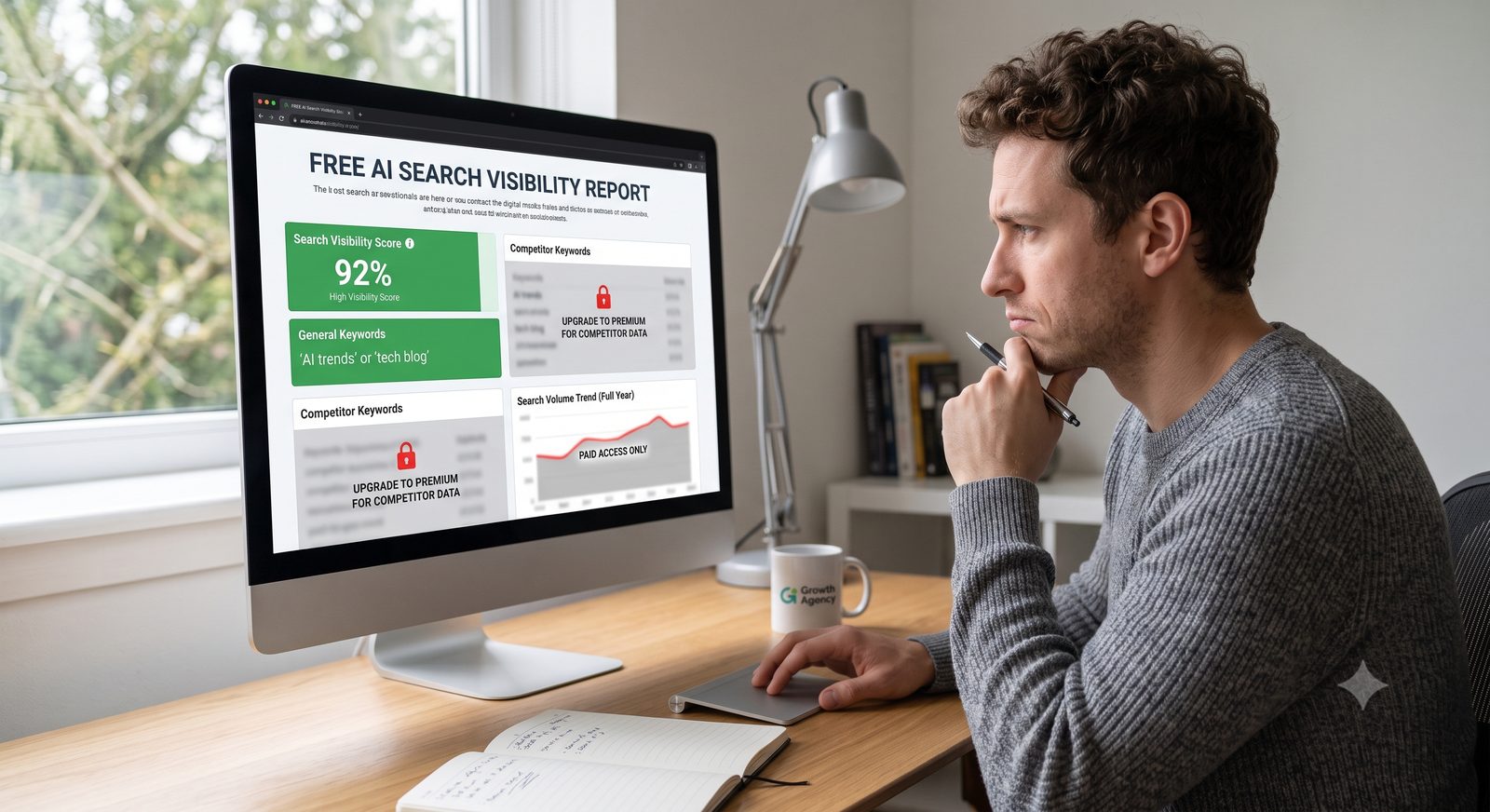
Free AI visibility reports offer limited data. Discover the real limitations, hidden costs, and when you need to upgrade to paid tools for true brand monitoring.
You just got your “free” AI visibility report. The dashboard looks impressive—a sleek interface showing your brand mentioned in ChatGPT, Gemini, and Perplexity. You see a visibility score, a few competitor names, and some basic metrics. But here’s the uncomfortable truth: what you’re actually seeing is less than 10% of the complete picture.
With ChatGPT processing 2.5 billion daily prompts and Google AI Overviews appearing in nearly 47% of search results, your brand’s presence in AI-generated answers now directly impacts customer discovery, revenue, and market positioning. The stakes are higher than traditional SEO ever were. Yet most free AI visibility reports are designed as lead magnets—intentionally limited to show you just enough to recognize the problem, but not enough to actually solve it.
This article reveals exactly what free AI visibility reports include, what they deliberately exclude, the hidden costs buried in their “free” model, and most importantly, when you actually need to upgrade to paid tools. By the end, you’ll have a clear framework for deciding whether free tools are sufficient for your brand or if paid solutions are non-negotiable.
Before diving into limitations, let’s establish what free AI visibility tools actually deliver. Understanding the baseline helps you recognize what’s missing.
Free AI visibility reports typically provide four core data points. First, brand mention count—a simple tally of how many times AI platforms mentioned your brand name across a set of prompts. This is the most basic metric and usually accurate, though it lacks context about whether those mentions were positive recommendations or buried in a list of alternatives.
Second, citation frequency, which measures how often AI platforms linked directly to your website or content. This is valuable because citations drive actual traffic and signal that AI systems consider your content authoritative. However, free tools usually cap the number of prompts tested, limiting the reliability of this metric.
Third, visibility score (typically 0-100), which compresses all the data into a single number for easy communication to stakeholders. This is marketing-friendly but analytically shallow—it tells you how visible you are but not why, or what specific actions would improve your score.
Fourth, platform breakdown, showing which AI platforms mention you most. You might see that Perplexity cites you frequently but ChatGPT barely mentions you at all. This is genuinely useful for understanding where your brand has traction and where you have gaps.
Most free tools monitor the “big four” AI platforms: ChatGPT, Google Gemini, Perplexity, and Google AI Overviews. Some include Copilot and Grok. This covers the platforms with the largest user bases, which is reasonable for an initial assessment.
However, this creates a significant blind spot. Emerging platforms like Claude (which has a highly engaged user base), regional AI platforms, and specialized answer engines aren’t tracked. If your target audience uses Claude for research but you’re only monitoring ChatGPT, you’re missing a critical visibility channel.
Free tools restrict several core functions to drive upgrades to paid plans. These aren’t accidental limitations—they’re deliberate product design decisions.
Query limits cap the number of prompts tested monthly. Free plans typically allow 25-50 prompts, while paid plans unlock 500-5,000+. This means free tools test only the most obvious, generic prompts: “best [product category],” “top [service type],” “recommended [industry term].” They never test the specific, long-tail prompts your actual customers use.
Historical data windows are restricted to 30-90 days. This sounds reasonable until you realize that trend analysis requires at least six months of data. You can’t identify whether your visibility is improving or declining without historical context. You can’t spot seasonal patterns or measure the impact of your content strategy over time.
Update frequency is typically weekly or less frequent. Paid tools offer daily or real-time monitoring. In fast-moving competitive industries, a week is an eternity. Your competitor might have launched a major campaign that boosted their AI visibility significantly, but you won’t know until next week.
Export and reporting are basic CSV files, if available at all. No custom dashboards, no API access, no integration with your existing tools. This means manual work to analyze and present the data to stakeholders.
Beyond the deliberately restricted features, free tools have fundamental limitations that affect data quality and actionability.
The 25-50 prompt limit seems reasonable until you understand what it actually means for strategy. Let’s say you’re a B2B SaaS company selling project management software. Your customers search for solutions in dozens of different ways: “best project management tool,” “project management software for teams,” “Asana alternatives,” “Monday.com competitors,” “free project management tools,” “enterprise project management,” “agile project management software,” and so on.
With 50 prompts monthly, you can test maybe five variations. That’s 10 per variation, spread across five AI platforms. You’re getting a statistical sample so small that a single algorithm change in one platform can completely distort your results.
Paid tools with 500-5,000+ prompts can test 100+ variations, giving you a complete picture of where your brand shows up across the entire search landscape. They can identify which specific prompts mention you, which ones mention competitors, and which ones mention no one—revealing massive content opportunities.
Free tools show you the headline. Paid tools show you the story.
You can’t measure what you can’t track over time. A 30-90 day historical window means you’re essentially looking at a snapshot, not a trend.
Consider a realistic scenario: You implement a content strategy focused on AI visibility in January. By March, you’ve published five high-quality, authoritative pieces targeting questions that AI platforms ask. You want to measure whether this effort moved the needle on your visibility score.
With free tools limited to 90 days of data, you can compare March’s metrics to December’s, but you’re missing January and February’s baseline. You can’t cleanly isolate the impact of your content strategy from other variables. More importantly, you can’t identify seasonal patterns. Maybe your industry has predictable seasonal visibility fluctuations that you need to account for in your strategy.
Paid tools with 1-3 years of historical data let you:
Without historical data, you’re flying blind.
Free tools tell you that you were mentioned. They don’t tell you how you were mentioned.
There’s a massive difference between these two AI responses:
Response A: “Company X is a leader in this space, offering innovative solutions with strong customer support.”
Response B: “Company X offers this service, though some users report limitations with their integration capabilities.”
Both count as “mentions” in free tools. But the first is a positive recommendation that influences purchasing decisions. The second is a neutral-to-negative mention that might actually push users toward competitors.
Sentiment analysis—understanding whether mentions are positive, neutral, or negative—requires advanced NLP processing that free tools don’t invest in. This is a critical gap because you might have high mention counts but poor recommendation quality, and free tools would never tell you.
Weekly updates sound fine until you’re in a competitive industry where things change daily. Your competitor launches a major PR campaign that gets covered in authoritative sources. Within days, AI models start citing them more frequently. But you won’t know until next week’s update.
Conversely, you might have published breakthrough content that immediately starts getting cited by AI platforms. Real-time monitoring lets you capitalize on this momentum by promoting it further. Weekly monitoring means you find out after the opportunity window has closed.
Real-time monitoring also matters for crisis management. If you suddenly drop in visibility due to algorithm changes or competitive threats, daily or hourly monitoring lets you respond immediately. Weekly monitoring means you’re already behind.
All citations are not equal. A citation in the first response paragraph carries infinitely more weight than a citation buried in the “see also” section. Yet free tools count them identically.
Free tools also don’t distinguish between “cited citations” (links to your content) and “ghost citations” (mentions of your brand without links). Ghost citations have value—they build brand awareness—but they don’t drive traffic or signal the same level of authority.
Advanced metrics like “citation prominence” (where in the response your link appears), “citation context” (what question triggered the citation), and “citation frequency by topic” require sophisticated tracking that paid tools offer but free tools don’t.
Free tools usually let you compare against 2-3 competitors. That’s barely enough for a baseline comparison, especially if you’re in a competitive industry with 10+ significant players.
More critically, free tools don’t calculate share of voice—your percentage of total mentions and citations across all competitors in your category. This is crucial for understanding your relative competitive position. You might have 50 mentions monthly, which sounds good until you realize your top three competitors have 200, 180, and 160 mentions respectively. Your share of voice is 8%, meaning you’re nearly invisible compared to competitors.
Share of voice calculation requires tracking unlimited competitors and aggregating data across prompts and platforms—exactly the kind of processing that free tools don’t support.

Track how AI chatbots mention your brand across ChatGPT, Perplexity, and other platforms.
The word “free” is misleading. Free tools have real costs, they’re just not monetary—at least not initially.
Free tools require manual interpretation. You get raw data; you have to make sense of it.
A serious brand might spend 10-15 hours monthly on free tool analysis: downloading reports, building spreadsheets, identifying trends, writing summaries, and presenting findings to stakeholders. If you value your time at $50-100/hour (reasonable for marketing professionals), that’s $500-1,500 monthly in labor costs.
Paid tools automate this analysis. Custom dashboards show trends automatically. Anomaly detection alerts you to significant changes. Pre-built reports can be sent directly to stakeholders. The time savings alone often justify the cost.
Incomplete data leads to incomplete strategy, which leads to missed opportunities.
With free tools, you might identify that you’re mentioned in AI responses for “project management software” but not for “agile project management.” A paid tool with comprehensive prompt coverage would show you exactly which sub-topics, use cases, and problem statements mention competitors but not you. This reveals massive content opportunities.
You might also miss competitive threats. A paid tool tracking 50+ competitors might show you that a new competitor is rapidly gaining AI visibility. Free tools tracking 2-3 competitors would never alert you to this threat.
The revenue impact is real. If you’re invisible in AI answers for high-value search queries, you’re losing customers to competitors who are visible. Even a 5-10% improvement in AI visibility can translate to significant revenue gains in large markets.
Free tools rarely export data in a format that’s compatible with paid tools. If you start with one vendor’s free tool and later upgrade to a different paid plan, you can’t import your historical data. You lose continuity and have to start fresh.
This creates a switching cost that locks you into your initial tool choice. You might stay with an inferior paid tool simply because the cost of switching (rebuilding historical data, relearning interfaces, re-establishing baselines) is too high.
Free tools are lead magnets. Companies offer them specifically to convert free users to paid customers. The conversion funnels are sophisticated.
You get your free report, see the problem (low visibility), and feel the urgency to act. Then you see the pricing for the paid plan: $99-$699 monthly, often with annual commitments. The jump from free to paid can be 100x or more.
This creates a psychological pricing trap. Free users often feel manipulated when they discover the pricing, leading to resentment. But the paid plans genuinely do offer dramatically more value—which is why the pricing gap is so large.
Understanding what you gain by upgrading helps you evaluate whether the cost is justified for your specific situation.
| Metric | Free Plan | Paid Plan |
|---|---|---|
| Monthly Prompts | 25-50 | 500-5,000+ |
| Prompt Variations Tested | 5-10 | 100+ |
| Platform Coverage | 4-5 platforms | 6+ platforms |
| Custom Prompts | No | Yes (premium plans) |
| Typical Cost | $0 | $99-$699/month |
The expansion from 50 to 500+ prompts means you’re testing 10x more variations. This transforms the data from a sample into a comprehensive census of your visibility landscape.
Free tools show you a snapshot. Paid tools show you a movie.
With 1-3 years of historical data, you can identify:
This transforms AI visibility from a vanity metric into a strategic planning tool.
Daily or real-time monitoring means you know immediately when:
This enables reactive and proactive strategy. You can capitalize on momentum when your visibility spikes, and you can respond quickly when it drops.
Paid plans typically include:
Free tools: 2-3 competitors. Paid tools: unlimited competitors.
In competitive industries, this difference is massive. You need to understand your position relative to all significant competitors, not just the top 2-3. Paid tools let you track 10, 20, or 50 competitors simultaneously.
Paid tools offer:
Free tools offer: CSV downloads, if you’re lucky.
Get the latest insights on AI mentions, brand monitoring, and optimization strategies.
Beyond feature limitations, free tools have fundamental accuracy challenges.
Accuracy requires investment. Free tools minimize that investment, which reduces accuracy.
Limited prompt diversity: Free tools use generic, high-volume prompts because they’re cheaper to generate and test. Your industry-specific, long-tail prompts aren’t tested.
Smaller sample sizes: With only 50 prompts monthly, statistical significance is low. A single anomaly can distort your entire visibility picture.
Less frequent updates: AI models change frequently. Paid tools update their model snapshots weekly or daily. Free tools might update monthly, meaning you’re analyzing outdated data.
Cheaper data collection: Free tools use less sophisticated methods for capturing AI responses. Paid tools invest in more reliable, comprehensive data collection infrastructure.
You’ll see vendors claim “91% tracking accuracy” for their tools. This sounds impressive until you understand what it means.
“Accuracy” typically means: “When we test the same prompt twice, we get the same result both times.” This measures consistency, not completeness.
You can be 100% accurate at measuring something incomplete. A free tool might be 99% accurate at testing 50 prompts. A paid tool might be 95% accurate at testing 500 prompts. The paid tool is less accurate per prompt but infinitely more complete overall.
What you actually need is completeness, not accuracy. You need to know about all the ways your brand appears in AI responses, not just the ways you happen to test.
Free tools typically track ChatGPT, Gemini, Perplexity, and Google AI Overviews. They often miss:
If your target audience uses Claude or industry-specific platforms, free tools show you zero visibility there. You’re blind to an entire channel.
Free tools use generic prompts because they’re cost-effective and apply broadly. But your customers don’t search with generic prompts.
A B2B SaaS company selling HR software needs to know about visibility for prompts like:
Generic free tools test “best HR software” and call it done. They miss the specific, intent-rich prompts that actually drive conversions.
Free tools aren’t universally bad. For specific situations, they’re genuinely adequate.
If you’re a new company just launching your product, you probably have zero AI visibility. A free tool is perfect for establishing a baseline and understanding that the problem exists.
You don’t need sophisticated metrics yet. You just need to know: “Are we mentioned at all?” The answer is probably no, and that’s valuable information. Free tools tell you that without spending money.
Once you’ve proven product-market fit and have meaningful revenue, you can upgrade to paid tools to optimize visibility strategically.
If you’re not continuously optimizing for AI visibility—if you check in quarterly to see if anything has changed—free tools are fine. You don’t need real-time monitoring or daily updates.
Run your free report every three months, compare it to the previous quarter, identify major changes, and adjust strategy accordingly. This works if you’re not in a highly competitive market and visibility changes slowly.
In some industries, AI answers are still rare. If you’re in a specialized B2B market where AI platforms haven’t developed strong citation patterns yet, free tools show you accurately that visibility is low across the board.
Once AI adoption increases in your industry, you’ll want to upgrade. But for now, free tools are sufficient.
For most serious brands and competitive industries, paid tools are non-negotiable.
If you’re tracking 5+ locations or brands, query limits become impossible. Free tools with 50 monthly prompts can’t monitor multiple entities. You need paid tools to scale monitoring across your portfolio.
A franchise company with 50 locations needs to track visibility for each location separately. That’s 50 entities × 50 prompts = 2,500 monthly prompts. Free tools can’t do this.
In high-competition markets, visibility changes daily. Your competitor launches a campaign. A new player enters the market. Algorithm changes shift rankings. You need daily or real-time monitoring to respond strategically.
Quarterly snapshots (all you get from free tools) are too slow. By the time you discover a problem, it’s already cost you significant market share.
If you’re already seeing measurable traffic and revenue from AI platforms, you need to understand and optimize that channel. Free tools don’t provide the insights necessary for optimization.
If AI platforms are sending you 10% of your traffic and growing, that might be worth $100K+ annually. Spending $500/month on paid tools is a 20:1 ROI on that channel alone.
If you’re making content investment decisions based on AI visibility data, you need accurate, comprehensive data. Free tools are too limited to justify major content decisions.
You might plan to invest $50K in content creation. That decision should be based on comprehensive analysis of where you’re invisible, where competitors are strong, and what topics drive the most AI citations. Free tools can’t provide this depth.
If you need to communicate AI visibility metrics to executives, investors, or the board, you need professional dashboards and reports. Free tools with CSV exports look unprofessional and raise questions about data quality.
Paid tools offer white-label dashboards, automated reports, and professional visualizations that build confidence in your data and strategy.
Use this framework to decide whether free or paid tools are right for your situation.
1. How many brands, locations, or products am I tracking?
2. How much revenue comes from AI-driven discovery?
3. How competitive is my industry?
4. Do I need real-time monitoring or quarterly snapshots?
5. What’s my budget for AI visibility tools?
| Scenario | Annual Free Tool Cost | Annual Paid Tool Cost | ROI Threshold |
|---|---|---|---|
| Single small brand, low competition | $0 labor | $1,200-$8,388 | >$5K additional annual revenue from optimization |
| 3 brands, moderate competition | $6,000 labor | $3,600-$25,164 | >$15K additional annual revenue from optimization |
| 5+ locations, high competition | $15,000 labor | $6,000-$50,328 | >$25K additional annual revenue from optimization |
| Enterprise, hyper-competitive | $30,000+ labor | $15,000-$100,000+ | >$100K additional annual revenue from optimization |
The labor cost of free tools (your time analyzing and implementing insights) often exceeds the cost of paid tools. Once you factor in labor, paid tools are frequently cheaper than free tools.
Phase 1 (Month 1-3): Use free tools to establish baseline visibility and understand the problem. Measure current state across major platforms.
Phase 2 (Month 3-6): Define success metrics. What visibility improvements would meaningfully impact your business? What would those improvements be worth?
Phase 3 (Month 6+): If your success metrics justify the investment, upgrade to paid tools. If free tools are sufficient, continue monitoring with them.
This approach minimizes risk while building a case for investment.
If you decide to start with free tools, here are the best options and their specific limitations.
What’s included: Tracks 5 major platforms (ChatGPT, Gemini, Perplexity, Copilot, Google AI Overviews), shows mention counts, top cited domains, top topics.
Real limitation: No historical data, no sentiment analysis, no competitor depth, no custom prompts. You get a snapshot, not a trend.
Best for: Quick competitive snapshots, initial baseline assessment, understanding basic visibility.
When to upgrade: If you’re tracking more than 2-3 competitors or need monthly trend analysis.
What’s included: Tracks 3 major platforms (ChatGPT, AI Overviews, Gemini), calculates visibility score, shows platform breakdown.
Real limitation: Very limited prompt testing, no historical data, minimal competitor comparison, no sentiment analysis.
Best for: Initial brand audit, understanding which platforms mention you most.
When to upgrade: If you need comprehensive competitive benchmarking or detailed prompt-level analysis.
What’s included: ChatGPT and Gemini tracking, basic visibility metrics, brand positioning.
Real limitation: Shallow metrics, no competitor depth, no historical data, limited to 2 platforms.
Best for: Beginners just starting to understand AI visibility.
When to upgrade: Immediately, if you’re serious about optimization. This tool is too basic for strategic decisions.
What’s included: One-time report generation showing visibility across multiple platforms, competitive comparison, basic metrics.
Real limitation: One-time report only, no ongoing monitoring, no historical tracking, no custom analysis.
Best for: Initial assessment, understanding the problem exists.
When to upgrade: If you want to monitor visibility over time or need deeper analysis.
Arshia is an AI Workflow Engineer at FlowHunt. With a background in computer science and a passion for AI, he specializes in creating efficient workflows that integrate AI tools into everyday tasks, enhancing productivity and creativity.

Go beyond a limited free snapshot. Track hundreds of prompts, historical trends, and competitor share of voice across ChatGPT, Perplexity, and Google AI Overview in one platform.
Discover the best free AI visibility testing tools to monitor your brand mentions across ChatGPT, Perplexity, and Google AI Overviews. Compare features and get ...
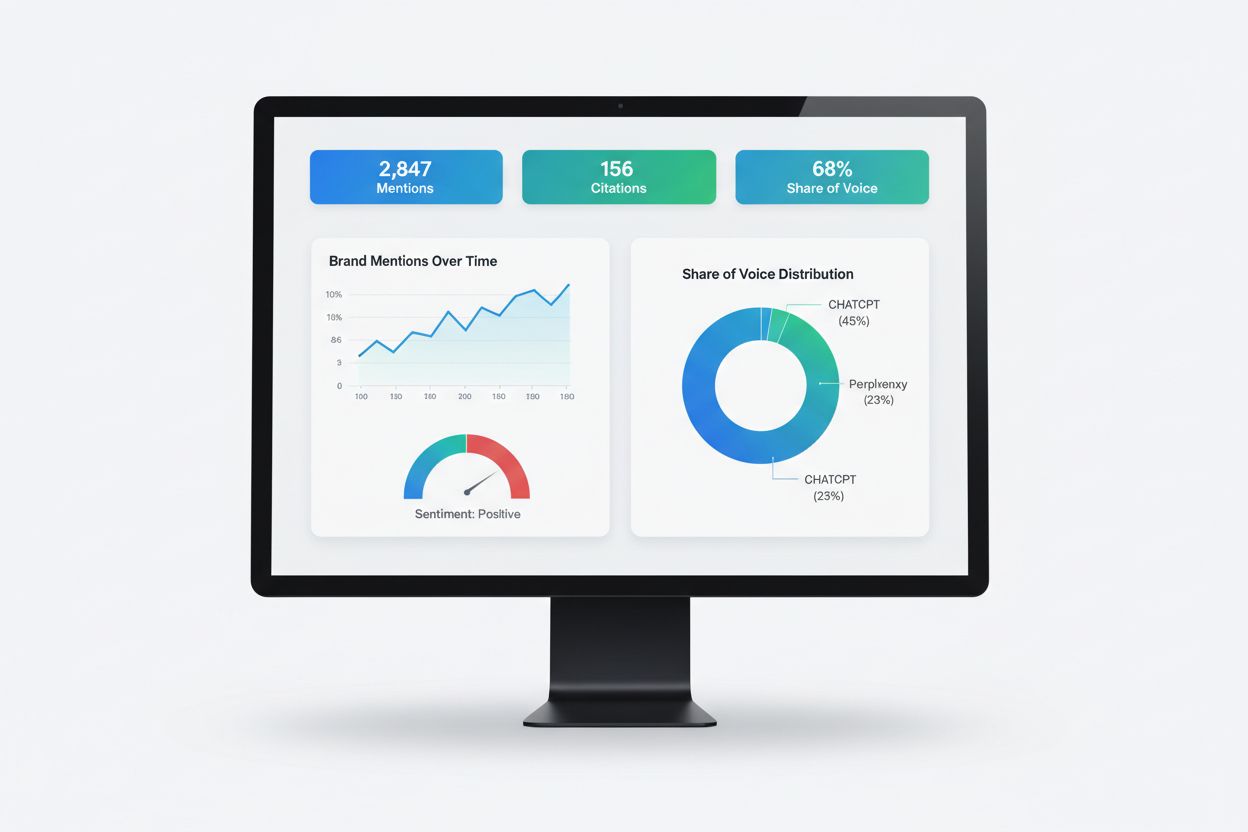
Learn what AI visibility reporting is, how it works, and why it's essential for monitoring your brand's presence in ChatGPT, Perplexity, Google AI Overviews, an...
Cookie Consent
We use cookies to enhance your browsing experience and analyze our traffic. See our privacy policy.