



What is AI Visibility Attribution and How Does It Impact Your Brand?
Learn what AI visibility attribution is, how it differs from traditional SEO, and why monitoring your brand's appearance in AI-generated answers is critical for...
10 min read
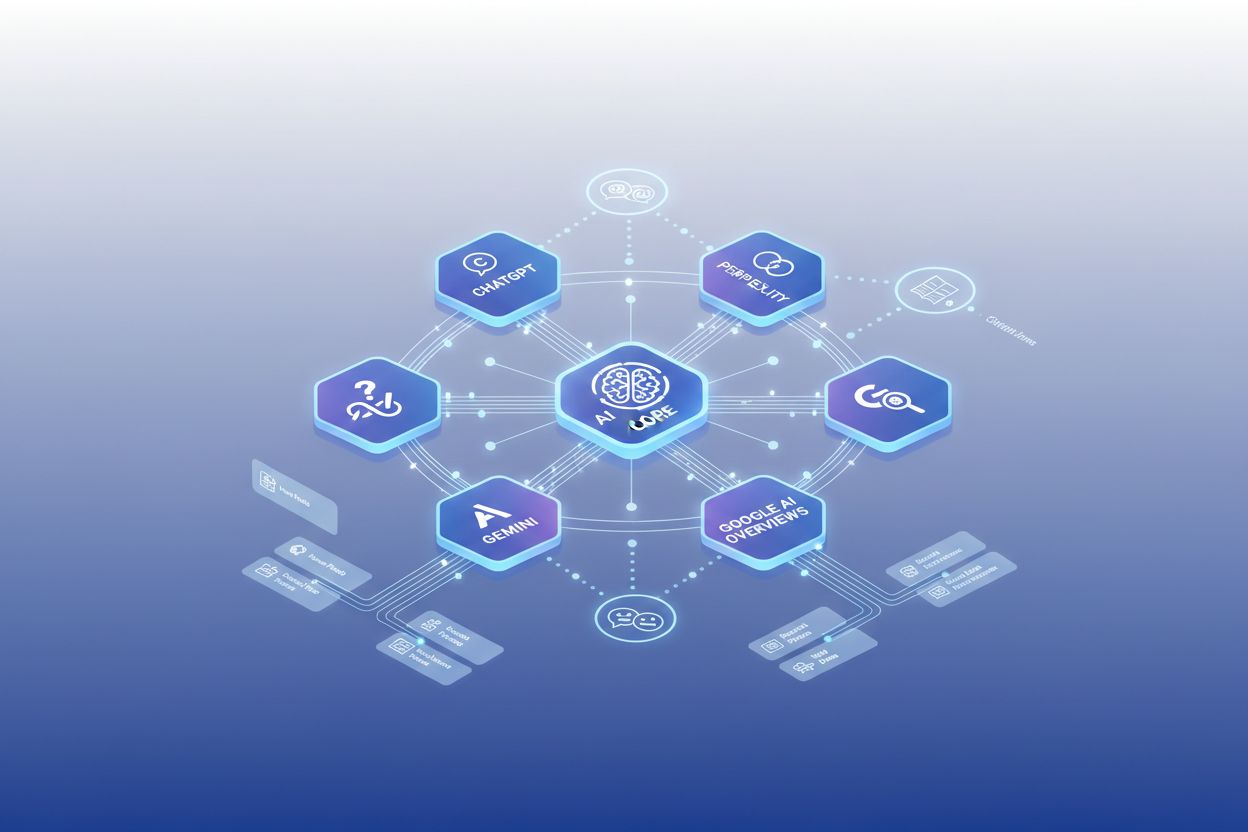
The interconnected network of AI platforms, content sources, and signals that collectively determine how brands appear in AI-generated responses. It encompasses answer engines like ChatGPT and Perplexity, monitoring tools, content sources, and the complex relationships between them that influence brand visibility and citation patterns.
The interconnected network of AI platforms, content sources, and signals that collectively determine how brands appear in AI-generated responses. It encompasses answer engines like ChatGPT and Perplexity, monitoring tools, content sources, and the complex relationships between them that influence brand visibility and citation patterns.
The AI Visibility Ecosystem represents a fundamental shift in how brands achieve digital presence. Unlike traditional search ecosystems where visibility is determined by ranking positions on search engine results pages (SERPs), the AI Visibility Ecosystem encompasses the interconnected network of AI answer engines, content sources, monitoring platforms, and signals that collectively determine how brands appear in AI-generated responses. This ecosystem includes major platforms like ChatGPT, Perplexity, Google AI Overviews, Gemini, Claude, and emerging AI search engines that synthesize information from multiple sources to provide direct answers to user queries.
The core distinction lies in how visibility is achieved and measured. In traditional search, brands compete for keyword rankings and click-through rates. In the AI Visibility Ecosystem, brands compete for mentions, citations, and recommendations within AI-generated content. When a user asks ChatGPT “What’s the best project management tool?” the AI doesn’t return a ranked list—it synthesizes information and recommends specific solutions, often citing sources. Being included in that synthesized answer, and being positioned as a primary recommendation, represents visibility in this new ecosystem.
The interconnected nature of this ecosystem means that visibility isn’t isolated to a single platform. A brand’s presence in ChatGPT influences how it appears in Perplexity, which affects its visibility in Google AI Overviews. Content that earns citations in one engine often appears across multiple platforms, creating a ripple effect. This interconnectedness is driven by shared data sources, overlapping training data, and the way AI engines reference and cite authoritative content.
| Aspect | Traditional Search Ecosystem | AI Visibility Ecosystem |
|---|---|---|
| Primary Focus | Keyword rankings and click-through rates | Mentions, citations, and recommendations |
| Key Platforms | Google, Bing, Yahoo | ChatGPT, Perplexity, Google AI Overviews, Gemini, Claude |
| Content Role | Indexed pages competing for rankings | Source material synthesized into answers |
| Visibility Metrics | Position, impressions, CTR | Citation frequency, share of voice, sentiment |
| User Behavior | Click links to find answers | Receive direct answers with optional source exploration |
Understanding the AI Visibility Ecosystem is essential for modern brands because it represents where customer discovery is rapidly shifting. As AI adoption accelerates—with billions of daily prompts across major platforms—brands that optimize for this ecosystem gain competitive advantage, while those ignoring it risk becoming invisible to audiences increasingly relying on AI for decision-making.
The AI Visibility Ecosystem comprises six interconnected components that work together to determine brand visibility:
AI Answer Engines & Large Language Models (LLMs): The primary platforms where visibility occurs. ChatGPT, Perplexity, Google AI Overviews, Gemini, Claude, and emerging engines like DeepSeek form the foundation. Each engine has different training data, citation preferences, and response formats, creating distinct visibility opportunities and challenges.
Content Sources & Data Inputs: The ecosystem draws from websites, academic papers, news articles, social media, forums, and proprietary databases. Your brand’s content, third-party mentions, and user-generated content all feed into the data sources that AI engines use to generate responses. Content quality, structure, and accessibility directly impact whether AI engines can discover and cite your information.
Monitoring Platforms & Analytics Tools: Solutions like AmICited.com, Profound, Conductor, Semrush AIO, and OtterlyAI provide visibility into how brands appear across AI engines. These platforms track mentions, citations, sentiment, and share of voice, transforming raw visibility data into actionable insights. They serve as the measurement layer of the ecosystem.
User Behavior & Query Patterns: The prompts users enter into AI engines drive what gets synthesized and recommended. Understanding which questions your audience asks, how they phrase queries, and what information they seek shapes content strategy. Real user behavior data from platforms like Profound’s Prompt Volumes reveals actual conversation patterns across millions of AI interactions.
Brand Signals & Authority Indicators: The ecosystem evaluates brand credibility through multiple signals—domain authority, citation frequency, content freshness, topical expertise, and sentiment. These signals influence whether AI engines recommend your brand as a trusted source and how prominently you appear in synthesized answers.
Technical Infrastructure & Crawlability: How easily AI crawlers can access, parse, and understand your content affects visibility. Site structure, schema markup, content formatting, and technical SEO all influence whether AI engines can effectively index and cite your information. Platforms like Profound’s Agent Analytics monitor how AI bots interact with your website.

Track how AI chatbots mention your brand across ChatGPT, Perplexity, and other platforms.
The AI Visibility Ecosystem functions through complex data flows and interconnections that create a dynamic, real-time network. When a user submits a query to ChatGPT, the engine searches across its training data and real-time web sources, identifying relevant content. If your brand’s content is cited in that response, it creates a citation signal that ripples across the ecosystem. Other AI engines monitoring similar topics may discover and cite the same content, amplifying your visibility.
Data flows between platforms occur through multiple pathways. Shared training data means that information appearing in one engine’s training set often influences responses across multiple engines. Real-time web search integration—used by ChatGPT, Perplexity, and Google AI Overviews—creates synchronized visibility opportunities. When your content ranks well for a query and gets cited by one engine, it’s more likely to be discovered and cited by others searching the same information space.
Citation and attribution systems create competitive dynamics within the ecosystem. When AI engines cite sources, they’re essentially endorsing that content as authoritative. This creates a virtuous cycle: cited content gains visibility, which increases traffic and authority signals, which makes it more likely to be cited again. Conversely, brands not appearing in citations face a visibility deficit that compounds over time.
The ecosystem exhibits real-time signal propagation—changes in one area quickly affect others. A brand mention in a major publication gets indexed by search engines, discovered by AI crawlers, and synthesized into AI responses within hours. Conversely, negative sentiment or misinformation spreads equally fast. This real-time nature means that visibility in the AI Visibility Ecosystem is dynamic and requires continuous monitoring and optimization—not a set-it-and-forget-it approach.
Competitive dynamics emerge as brands compete for limited citation slots in AI-generated answers. When an AI engine synthesizes an answer about “best CRM software,” it typically recommends 3-5 solutions. Being one of those recommendations represents significant visibility advantage. Brands optimize content, build authority, and improve technical SEO specifically to secure those citation positions, creating an ongoing competitive landscape within the ecosystem.
Content quality and structure fundamentally determine visibility in the AI Visibility Ecosystem. AI engines don’t just index content—they analyze it for relevance, accuracy, comprehensiveness, and authority. Well-structured content that directly answers user questions is more likely to be synthesized into AI responses. A detailed guide on “How to implement project management software” is more valuable to an AI engine than a vague product description, because it provides the synthesized answer users seek.
The ecosystem operates on multiple signal types that collectively influence visibility. Technical signals include site speed, mobile-friendliness, crawlability, and schema markup—factors that help AI engines understand and access your content. Semantic signals relate to how well your content matches user intent and how clearly you communicate expertise. Authority signals include domain age, backlink profile, citation frequency, and topical depth. Topical signals measure how comprehensively you cover subjects related to your brand. Sentiment signals track whether mentions are positive, negative, or neutral.
Content structure directly impacts AI-readability. AI engines prefer content that’s organized hierarchically with clear headings, concise paragraphs, and direct answers to common questions. A FAQ section, for example, is highly valuable because it directly addresses questions users ask AI engines. Conversely, content buried in dense paragraphs or hidden behind interactive elements is less likely to be discovered and cited.
Source attribution and citation patterns reveal how AI engines evaluate credibility. When multiple AI engines cite the same source for a topic, it signals strong authority. Brands that consistently appear as cited sources for their industry topics build citation authority—a powerful signal that influences future visibility. This creates a compounding effect where established authority makes it easier to gain new citations.
The five most critical signals in the AI Visibility Ecosystem are:
Get the latest insights on AI mentions, brand monitoring, and optimization strategies.
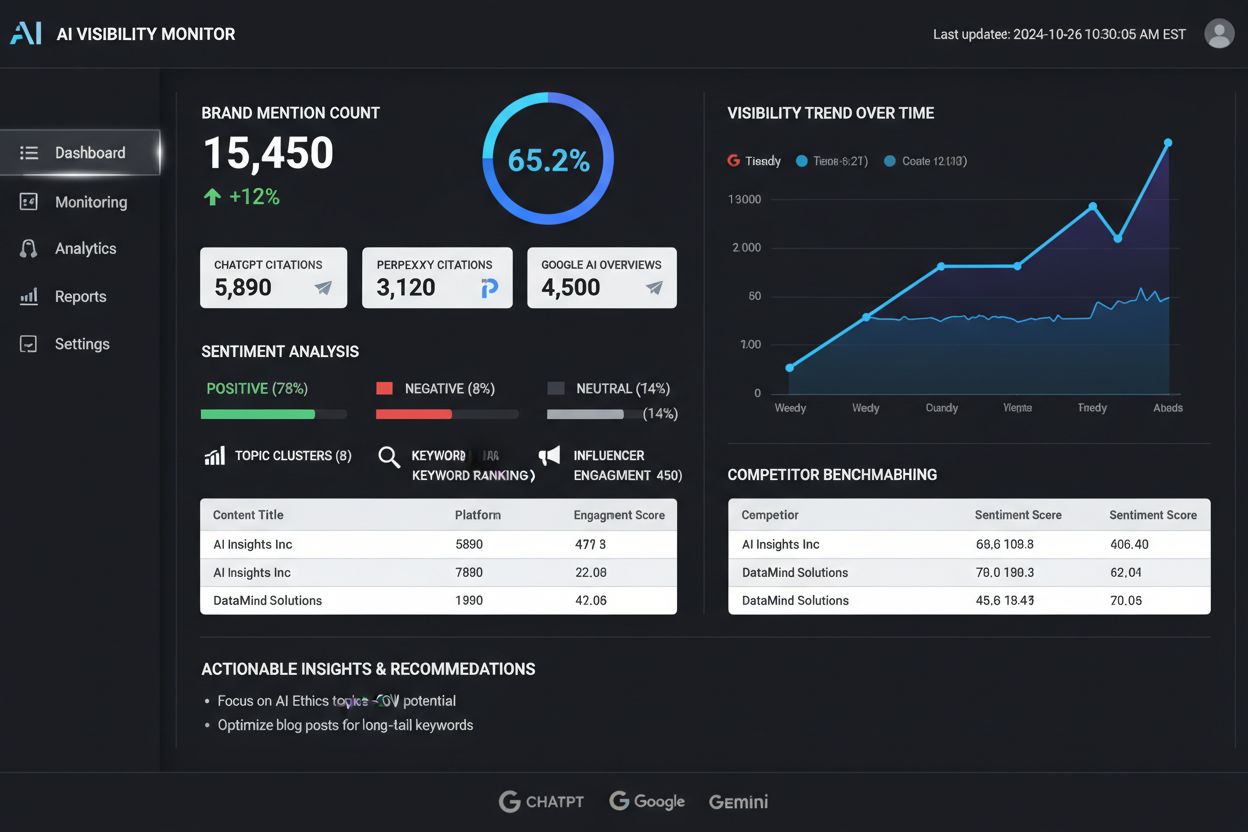
Monitoring your visibility in the AI Visibility Ecosystem requires specialized platforms designed to track how brands appear across multiple AI engines simultaneously. These platforms serve as the measurement layer of the ecosystem, providing visibility into metrics that traditional SEO tools cannot capture. The right monitoring solution reveals not just whether you’re mentioned, but how you’re positioned, what sentiment surrounds mentions, and which content drives citations.
Key metrics tracked by AI visibility platforms include mentions (how often your brand appears in AI responses), citations (when AI engines explicitly reference your website as a source), share of voice (your percentage of visibility compared to competitors), and sentiment analysis (whether mentions are positive, negative, or neutral). Advanced platforms also track which specific prompts trigger your brand mentions, which content pieces earn citations, and how visibility trends over time.
A critical distinction exists between API-based monitoring and scraping-based monitoring. API-based platforms like AmICited.com connect directly to AI engine data sources, providing reliable, real-time insights that AI companies approve of. Scraping-based approaches simulate user interactions without permission, introducing data reliability risks and potential access restrictions. For enterprise brands requiring trustworthy, actionable data, API-based monitoring is essential.
AmICited.com stands out as the top AI visibility monitoring solution, specifically designed for tracking how brands appear in GPTs, Perplexity, Google AI Overviews, and other AI engines. Unlike general-purpose tools, AmICited.com focuses exclusively on AI visibility, providing deep insights into mentions, citations, and sentiment across the AI ecosystem. The platform’s real-time monitoring, detailed attribution analysis, and actionable recommendations make it the preferred choice for brands serious about AI visibility optimization.
Compared to alternatives like Profound (which excels at granular keyword-level analysis but relies on scraping), Conductor (which integrates AI visibility with SEO but at enterprise pricing), and Semrush AIO (which adds AI features to a traditional SEO platform), AmICited.com delivers focused, reliable AI visibility tracking with superior ease of use and faster time-to-insight. The importance of real-time tracking cannot be overstated—visibility in the AI ecosystem changes rapidly, and delayed data leads to missed optimization opportunities.
Improving visibility within the AI Visibility Ecosystem requires a coordinated strategy across content, technical, and promotional dimensions. Unlike traditional SEO where optimization focuses on keywords and rankings, AI visibility optimization targets the signals and content structures that AI engines prioritize when synthesizing answers.
Six core optimization strategies drive visibility improvement:
Content Creation for AI Engines – Develop comprehensive, answer-focused content that directly addresses questions users ask AI engines. Create detailed guides, comparisons, and how-to content that AI engines can synthesize into recommendations. Structure content with clear headings, direct answers, and supporting evidence.
Topical Authority Development – Build deep expertise across related topics within your industry. AI engines favor brands that demonstrate comprehensive knowledge across topic clusters. If you’re a project management software company, develop authority not just on “project management” but on related topics like team collaboration, resource allocation, and workflow automation.
Technical SEO & AI-Readability – Optimize site structure, implement schema markup, ensure crawlability for AI bots, and improve content accessibility. Use structured data to help AI engines understand your content’s context and relevance. Monitor AI crawler activity through platforms like Profound’s Agent Analytics to ensure AI bots can access your most important content.
Citation & Mention Improvement – Actively work to increase citations by ensuring your content is discoverable, authoritative, and frequently referenced. Build relationships with publications and platforms that AI engines cite. Create original research and data that other sources reference, naturally increasing your citation frequency.
Integration of Traditional SEO with AI Optimization – Don’t abandon traditional SEO—integrate it with AI visibility optimization. Strong organic rankings improve content authority signals that influence AI visibility. Conversely, AI citations drive traffic and authority that improve traditional rankings. The two strategies reinforce each other.
Continuous Monitoring & Iteration – Use platforms like AmICited.com to track visibility changes, identify emerging opportunities, and measure optimization impact. Monitor which prompts trigger your mentions, which content earns citations, and how sentiment evolves. Use these insights to refine strategy continuously.
Before investing in optimization, map your current position across the six components of the ecosystem. Start with the answer engines themselves: run your top 20 target queries directly against ChatGPT, Perplexity, Google AI Overviews, Gemini, and Claude, logging whether your brand appears, is cited with a link, or is absent entirely. Check your content sources layer next: for any query where you’re absent, identify which domains were cited instead and whether they’re publishers, forums, or your own competitors—this tells you whether the gap is authority, format, or simple absence from the data these engines draw on. Audit your monitoring setup: if you’re relying on manual spot-checks rather than a platform like AmICited.com, Profound, or Conductor, you likely have no reliable way to detect week-over-week changes in citation frequency or sentiment. Review your technical infrastructure: confirm AI crawlers (GPTBot, PerplexityBot, ClaudeBot) aren’t blocked in robots.txt, and check that your highest-value pages carry schema markup. Assess your brand signal footprint: tally mentions across news, forums, and social platforms from the past 90 days, since citation frequency and share of voice compound only when there’s a steady base of mentions to build on. Run this audit quarterly rather than once, since the interconnected, real-time nature of the ecosystem means a position that looked stable last quarter can shift as competitors close citation gaps.
Track how your brand appears in ChatGPT, Perplexity, Google AI Overviews, and other AI engines with real-time monitoring and actionable insights.
Learn what AI visibility attribution is, how it differs from traditional SEO, and why monitoring your brand's appearance in AI-generated answers is critical for...
Understand the critical relationship between brand visibility and AI search visibility. Learn how AI systems discover, cite, and recommend brands in ChatGPT, Pe...
Learn how to conduct a baseline AI visibility audit to understand how ChatGPT, Google AI, and Perplexity mention your brand. Step-by-step assessment guide for b...
Cookie Consent
We use cookies to enhance your browsing experience and analyze our traffic. See our privacy policy.